



What Is the Best Solution for Moving Loads on Slopes? Alitrak vs Manual Methods
Moving heavy loads across sloped surfaces can create significant challenges for warehouses, industrial facilities, commercial properties and outdoor work environments. Whether transporting waste containers, trailers, equipment or wheeled materials, workers may need to manage additional force, maintain balance and control the movement of a load on an incline.
Moving Loads on Slopes requires careful consideration of load weight, gradient, surface condition, available traction and equipment used. Tasks that appear straightforward on level ground can become more physically demanding on ramps, driveways or uneven surfaces. Repeated manual pushing and pulling during Moving Loads on Slopes may increase physical demands and contribute to fatigue.
For businesses looking to improve material handling processes, electric tugs can provide an alternative to manual methods. The Alitrak OT-600, available from Emoveit, is designed to move compatible trailers, caravans, wagons and waste containers while reducing the manual effort required from operators.
Choosing suitable equipment for Moving Loads on Slopes can help businesses address handling challenges and improve workflow. The right solution depends on the specific load, route conditions and operating requirements.
This article compares manual methods with electric tug technology, highlighting key considerations for Moving Loads on Slopes and explaining how businesses can evaluate suitable equipment for their applications.
Why Is Moving Loads on Slopes More Difficult?
Moving a wheeled load on a gradient introduces different challenges compared with transporting the same load across a level floor. Gravity affects the force needed to move a load uphill and can increase the effort required to control it when travelling downhill.
The difficulty depends on several factors, including the load’s weight, wheel configuration, rolling resistance, gradient and surface condition. A heavy load with poorly maintained wheels may require substantial force to get moving, while a load travelling downhill may create additional demands on braking and operator control.
Common challenges associated with Moving Loads on Slopes include:
- Increased physical effort: Workers may need to apply greater force to move a loaded trolley, trailer or container uphill.
- Reduced traction: Wet, muddy, loose or uneven surfaces can affect the grip available to workers and equipment.
- Load control: A wheeled load can accelerate downhill if its movement is not properly controlled.
- Musculoskeletal strain: Repetitive or forceful pushing and pulling can contribute to back, shoulder, arm and other musculoskeletal injuries.
- Restricted manoeuvrability: Narrow access routes, confined work areas and changes in elevation can make positioning more difficult.
- Fatigue during repetitive tasks: Repeatedly transporting loads along the same incline can increase the cumulative physical demands of a job.
These risks should be assessed before selecting a handling method. Businesses need to consider the entire task, including starting the load, maintaining movement, changing direction, stopping and securing the load at its destination.
Manual Methods for Moving Loads on Slopes
Manual handling remains common in workplaces where loads are transported using hand trolleys, wheeled bins, carts and other non-powered equipment. These methods may be suitable for certain light loads and controlled environments, provided the risks have been assessed.
However, the suitability of manual handling changes when the route includes an incline.
1. Manual Pushing and Pulling
Workers may push or pull a trolley, waste container or trailer by hand to move it between work areas. On level surfaces, this approach may be practical when the load is manageable and the wheels roll freely.
On a slope, the physical demands can increase. Workers may need to apply greater force to move a load uphill and exert additional control to prevent unwanted movement downhill.
The ability to maintain a secure grip and stable footing is also important. If the load shifts unexpectedly or the worker loses traction, the task can become hazardous.
For businesses evaluating Moving Loads on Slopes, manual pushing and pulling should therefore be assessed according to the actual load, gradient, surface and frequency of movement rather than weight alone.
2. Using Non-Powered Trolleys
A suitable trolley can improve the handling of materials by allowing them to roll instead of being carried. Wheel size, bearing condition, handle design and load distribution all influence how easily the trolley moves.
Nevertheless, a non-powered trolley does not eliminate the force required from the operator. Workers must still initiate movement, maintain control and stop the load.
On sloping routes, the trolley’s braking arrangements, stability and suitability for the surface become particularly important. A trolley that performs adequately on a warehouse floor may not be appropriate for a steep or uneven outdoor access route.
3. Sharing the Task Between Workers
Some businesses allocate two workers to move a difficult load. Depending on the task, this may help distribute physical effort or improve coordination.
However, adding another worker does not automatically make the activity safe. Both workers must be able to communicate, maintain stable footing and control the load without adopting awkward postures. Coordinated stopping and turning can also be difficult when the load is bulky or visibility is restricted.
A better long-term approach may be to redesign the task or introduce suitable mechanical assistance.
What Are the Risks of Manual Load Movement?
Manual handling risks are not limited to lifting. Pushing, pulling, carrying, holding and restraining loads can also expose workers to hazardous forces and postures.
According to Safe Work Australia’s guidance on lifting, pushing and pulling, hazardous manual tasks can contribute to musculoskeletal disorders and should be assessed and managed.
When Moving Loads on Slopes, businesses should pay particular attention to the following risks.
Musculoskeletal Injuries
Repeatedly applying high force can place stress on muscles, tendons, joints and other tissues. The risk may increase when workers have to lean forward, twist their bodies or maintain an awkward position while moving a load.
Reducing the force required for each movement can help minimise these physical demands.
Slips, Trips and Falls
Sloped surfaces can make it more difficult to maintain balance while pushing or pulling a load. Wet weather, loose gravel, mud, damaged paving and obstructions may further increase the risk.
Workers may also have limited ability to use their hands to regain balance if they are gripping a heavy load.
Uncontrolled Load Movement
A load travelling downhill can gain momentum. If the operator cannot maintain adequate control, the load may collide with people, vehicles, equipment or structures.
Safe movement requires a suitable method of controlling speed, stopping and securing the load. An electric tug should not be treated as a substitute for an appropriate risk assessment or for any braking or restraint systems required by the application.
Fatigue and Reduced Productivity
Repeated manual movement can be physically demanding, particularly where loads must travel along the same incline many times per shift.
Fatigue may affect an operator’s ability to maintain consistent control and respond to changing conditions. It can also make repetitive handling less efficient over time.
For these reasons, Moving Loads on Slopes should be considered as part of a broader workplace safety and material handling strategy.

Alitrak Electric Tugs: An Alternative to Manual Methods
An electric tug uses powered movement to help transport compatible wheeled loads. Rather than requiring workers to supply all the force needed to move a load, the equipment provides powered assistance.
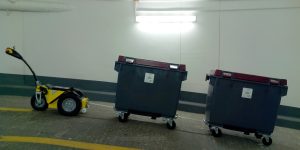
Electric tugs can be useful in applications involving trailers, caravans, industrial wagons and waste containers, depending on the tug’s capacity, coupling arrangement and operating conditions.
For businesses seeking a solution for Moving Loads on Slopes, the key consideration is not simply the tug’s maximum pulling capacity. Its suitability must also be evaluated against the gradient, load configuration, available traction, stopping requirements and the manufacturer’s operating limits.
Introducing the Alitrak OT-600
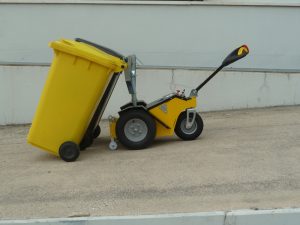
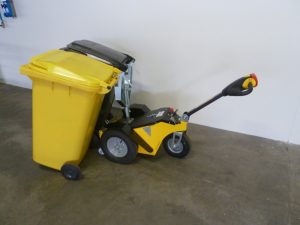
The Alitrak OT-600 is a three-wheeled, zero-emission electric pedestrian tug designed for outdoor applications. Emoveit supplies the unit for moving compatible loads such as trailers, caravans, wagons and commercial or residential waste containers.
Its compact design supports manoeuvring in smaller spaces, while its powered drive helps reduce the manual effort associated with repetitive movement.
The OT-600 is particularly relevant to Moving Loads on Slopes because its published specifications state that it can handle a 250 kg load on a 20% slope. This rating is an important starting point when evaluating the product for a suitable application, but the complete operating conditions must still be checked before use.
Read more about the Alitrak OT-600 electric tug at Emoveit.
Key Alitrak OT-600 Specifications
The published specifications include:
- Motor: 24 V / 600 W electric motor.
- Pulling capacity on a flat surface: Up to 2,000 kg.
- Loading capacity on a flat surface: Up to 300 kg.
- Published slope capability: A 250 kg load on a 20% slope.
- Wheels: Three.
- Pulling speeds: Approximately 2.5 km/h in slow mode and 5 km/h in fast mode.
- Pushing speeds: Approximately 1.8 km/h in slow mode and 3.5 km/h in fast mode.
- Parking brake: Electromagnetic.
- Dimensions: Approximately 1,370 mm long, 690 mm wide and 1,000 mm high.
- Weight: Approximately 130 kg.
Specifications are subject to change, so businesses should confirm the current product details with Emoveit before making a purchasing decision.
It is also important to distinguish the tug’s flat-surface pulling capacity from its slope capability. The published 2,000 kg pulling capacity does not mean that the OT-600 can move a 2,000 kg load up a 20% gradient. The stated slope rating is for a 250 kg load.
How Does the Alitrak OT-600 Compare with Manual Methods?
When comparing manual handling with an electric tug, businesses should consider the physical effort required, control requirements, suitability for the route and frequency of use.
1. Physical Effort
With manual pushing and pulling, the operator supplies the force required to initiate and maintain movement. This can become demanding when a load must travel uphill or when rolling resistance is high.
The OT-600 provides powered assistance for compatible loads, reducing the manual force needed to move them. This can be valuable for repetitive transport tasks, although operators must still guide the tug, monitor the route and manage the load safely.
2. Consistency of Movement
Manual movement can vary according to the operator’s strength, fatigue and ability to maintain traction.
A powered tug provides selectable operating speeds, allowing the operator to choose a suitable speed for the task within the equipment’s operating limits. The OT-600 has separate slow and fast speed settings for pushing and pulling.
Appropriate speed selection is especially important when Moving Loads on Slopes, where excessive speed or poor stopping control can create hazards.
3. Repetitive Transport Tasks
Manual methods may be practical when loads are light and movements are occasional. However, where staff repeatedly move compatible loads across the same route, powered assistance may reduce cumulative physical demands.
Potential applications for the OT-600 include moving waste containers, positioning trailers and transporting compatible wheeled equipment around outdoor facilities.
4. Manoeuvrability
Manual trolleys and carts vary considerably in their ability to navigate confined spaces. A powered tug must also be matched to the available operating area.
The OT-600’s compact dimensions can be advantageous where space is limited. Nevertheless, the turning area, load dimensions, coupling arrangement and operator visibility should all be checked before use.
5. Control and Stopping
Manual handling requires workers to maintain control of the load throughout the movement. On an incline, the ability to stop and secure the load becomes particularly important.
The OT-600 includes an electromagnetic parking brake, but businesses should not assume this alone guarantees safe operation on every gradient. Confirm the manufacturer’s instructions for stopping, parking and slope use, and assess whether additional load restraints or other controls are required.
How to Choose the Right Solution for Moving Loads on Slopes
Selecting the right equipment requires more than comparing maximum capacity figures. Before choosing between manual handling and an electric tug, assess the following factors.
1. Load Weight and Configuration
Record the actual weight of the load, including the trolley, trailer or container where relevant. Consider its dimensions, centre of gravity, wheel condition and coupling arrangement.
For Moving Loads on Slopes, confirm that the complete load configuration falls within the equipment’s rated limits for the intended gradient.
2. Slope Gradient
Measure the gradient of the route rather than estimating it visually. A 20% gradient means a rise of 20 units for every 100 horizontal units; it is not the same as a 20-degree incline.
Even when a product publishes a slope rating, that rating must be interpreted alongside the specified load and operating conditions. Do not extrapolate a published rating to heavier loads or different surfaces without manufacturer confirmation.
3. Surface Conditions
Assess whether the route is concrete, asphalt, gravel, compacted earth or another surface. Check for loose material, standing water, potholes, uneven transitions and other conditions that may affect traction or stability.
Outdoor equipment must be appropriate for the actual environment. A route that is suitable in dry weather may present different risks after rain.
4. Travel Distance and Frequency
Consider how far each load must travel and how often the task is repeated. A task that occurs dozens of times per shift may justify a different handling solution from an occasional movement.
Estimating task frequency can help businesses compare the operational benefits of powered equipment against its purchase, charging, maintenance and training requirements.
5. Stopping and Securing the Load
Determine how the load will be controlled during travel, particularly downhill, at corners and when approaching people or vehicles.
The operating procedure should specify how to start, stop, park and secure the equipment. If the route cannot be managed safely within the equipment’s rated capabilities, an alternative route or handling method may be necessary.
6. Operator Training and Maintenance
Workers should receive instruction on the equipment’s controls, limitations, coupling arrangements and emergency procedures.
Regular inspection and maintenance should cover relevant components such as wheels, tyres, steering, controls, brakes, batteries and connections. Defects should be addressed before the equipment returns to service.
Best Practices for Safer Load Movement on Inclines
Regardless of whether a business uses manual methods or powered equipment, safe procedures remain essential.
Recommended practices include:
- Assess the route, load, gradient and surface before starting work.
- Keep travel paths clear of people, vehicles, debris and obstructions.
- Use equipment that is correctly rated for the load and environment.
- Maintain suitable traction and inspect wheels, tyres and other relevant components.
- Use an appropriate speed and avoid sudden changes in direction.
- Establish safe stopping, parking and load-securing procedures.
- Avoid operating equipment outside the manufacturer’s stated limits.
- Provide suitable training and supervision.
- Review the process after changes to the load, route, equipment or working conditions.
When Moving Loads on Slopes, a powered tug should form part of a risk-managed handling system rather than being treated as a complete solution on its own.
Is an Electric Tug Better Than Manual Handling?
There is no single solution for every workplace. Manual handling may suit light loads and occasional tasks where risks are adequately controlled. However, Moving Loads on Slopes repeatedly with substantial force may make an electric tug a more suitable option.
The Alitrak OT-600 provides powered assistance for compatible wheeled loads, helping reduce manual effort while supporting controlled movement within its rated capabilities. It is worth considering for applications requiring outdoor mobility and suitable slope performance.
When comparing solutions for Moving Loads on Slopes, assess load weight, gradient, surface conditions, task frequency and stopping requirements to determine the most appropriate equipment.
Improve Your Load Handling Process with Emoveit
Moving Loads on Slopes can increase physical effort and make load control more challenging. Choosing suitable equipment for Moving Loads on Slopes can help reduce manual handling demands, improve workflow and manage workplace risks.
The Alitrak OT-600 provides powered assistance for compatible wheeled loads, with a published capability of handling a 250 kg load on a 20% slope. For safe Moving Loads on Slopes, suitability must be confirmed against the load, gradient, surface conditions and manufacturer guidelines.
If your business needs a solution for Moving Loads on Slopes, contact Emoveit to discuss whether the Alitrak OT-600 or another electric tug suits your application.
Contact Emoveit
Phone: 1300 213 010
Email: sales@emoveit.com.au
Product details: https://emoveit.com.au/product/alitrak-au_outdoor-tugs-600-watt-ot-600
Website: https://emoveit.com.au/