



How to Choose the Right Zallys K2 for Your Industrial Towing Application: 7 Essential Factors
Industrial facilities regularly move loaded trolleys, equipment, carts and materials between workstations, storage areas and production departments. As operational demands increase, manually moving heavy loads can become inefficient, physically demanding and difficult to manage consistently. An electric tug provides a powered alternative, helping businesses move multiple loads with greater control while reducing reliance on manual pushing and pulling.
Choosing the right equipment for an Industrial Towing Application requires more than looking at the maximum towing capacity. Businesses must consider the total weight of the load, floor conditions, travel distance, operating frequency, manoeuvrability and the type of connection required between the tug and the equipment being moved.
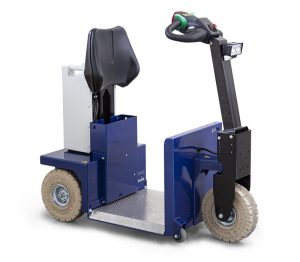
The Zallys K2 Stand-On Electric Tug is designed for businesses that need a compact, battery-powered solution for moving industrial loads. With a published towing capacity of up to 1,500 kg on flat ground with ballast, a 24V/800W motor and a maximum speed of 10 km/h, it provides a practical option for selected warehouse, manufacturing and commercial material-handling operations.
However, is the Zallys K2 the right choice for every Industrial Towing Application?
This guide explains the essential factors to consider when selecting an electric tug, how the Zallys K2 can support different workplace requirements and what businesses should assess before investing in powered towing equipment.
1. Understand Your Industrial Towing Application
The first step in selecting an electric tug is understanding exactly what needs to be moved. Different workplaces have different material-handling requirements, and the equipment must match the actual operating conditions.
An Industrial Towing Application may involve moving individual carts, several connected trolleys, loaded roll containers, production equipment or specialised industrial trailers. Each situation creates different demands on the towing vehicle.
Before selecting an electric tug, identify the following:
- Load weight: Determine the combined weight of the loaded trolley or equipment being towed.
- Load configuration: Establish whether the tug will move one trolley or several connected units.
- Travel distance: Consider how far the equipment needs to travel during each movement.
- Operating frequency: Identify how many towing cycles are required per shift.
- Workplace layout: Assess available turning space, aisle widths and access restrictions.
- Floor conditions: Determine whether the equipment will operate on smooth concrete, sealed floors or other surfaces.
- Connection requirements: Identify the hitch, hook or coupling needed to connect the tug to the load.
These details help establish whether a compact stand-on electric tug is suitable for the operation.
For businesses transporting loaded trolleys throughout warehouses or production facilities, the Zallys K2 can be considered where the required towing performance and workplace conditions fall within its specifications.
The objective is to select equipment that supports the entire Industrial Towing Application rather than choosing a machine based solely on its advertised maximum capacity.
2. Determine the Required Towing Capacity
Towing capacity is one of the most important specifications when comparing electric tugs. Selecting a machine with insufficient towing capability can result in poor performance, while purchasing equipment significantly larger than necessary may increase costs without delivering additional operational value.
The Zallys K2 is advertised with a maximum towing capacity of 1,500 kg on flat ground when fitted with ballast.
This makes it a potential option for selected medium-duty Industrial Towing Application requirements, particularly where businesses need to move loaded carts and trolley systems over suitable indoor surfaces.
However, maximum towing capacity should not be confused with the weight of the load that can be moved under every operating condition.
Actual towing performance is influenced by several factors:
- The combined weight of the trailer and its contents.
- The resistance created by the trailer wheels and bearings.
- The type and condition of the operating surface.
- The presence of slopes or gradients.
- The amount of ballast fitted to the tug.
- The type of wheels fitted to the tug and trailer.
- The acceleration, stopping and turning requirements.
For example, moving a loaded trolley across a smooth warehouse floor generally creates different demands from towing the same trolley over an uneven surface or an inclined ramp.
An Industrial Towing Application should therefore be assessed using the actual operating conditions, not just the maximum capacity shown in a product specification.
Businesses should also consider the towing force at the hitch. The Zallys K2 technical information identifies a maximum towing force at the hook, which is an important consideration when evaluating the resistance created by the load.
Where the application involves gradients, frequent starts and stops or unusually high rolling resistance, the required towing capacity should be confirmed with the equipment supplier before selecting the machine.
3. Consider the Advantages of the Zallys K2 Stand-On Design
The physical design of an electric tug influences how easily it can be operated in different workplaces.
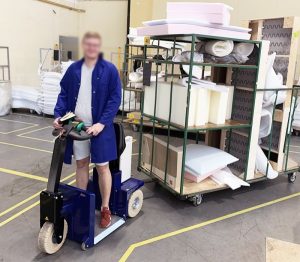
The Zallys K2 features a stand-on operating configuration, allowing the operator to travel with the machine rather than continuously walking behind it during towing operations.
This arrangement can be useful in facilities where regular movement between different work areas is required.
For an Industrial Towing Application involving repeated trolley transportation, the stand-on configuration can help streamline movement between collection points, storage areas, production departments and delivery locations.
The K2 also has a compact design, with published dimensions of approximately 1,234 mm in length and 557 mm in width.
Its relatively narrow footprint can be advantageous in facilities where space is limited and equipment needs to manoeuvre through designated access routes.
The published turning circle is approximately 1,900 mm, which should be considered when assessing aisle widths, corners and turning areas.
Before introducing the machine into a workplace, businesses should check that the available operating space accommodates both the tug and the full trailer combination.
The stand-on configuration is particularly worth considering for:
- Warehouse trolley transportation.
- Manufacturing material distribution.
- Supermarket and retail stock movement.
- Airport and commercial trolley operations.
- Internal logistics and distribution activities.
Selecting the correct configuration helps ensure the equipment suits the movement patterns and space restrictions of the facility.
4. Evaluate Motor Performance and Operating Speed
Motor performance determines how effectively an electric tug can move loads during everyday operations.
The Zallys K2 is equipped with a 24V/800W electric motor and has a published maximum operating speed of 10 km/h.
These specifications make it a consideration for businesses that need powered trolley movement across suitable industrial and commercial environments.
Unlike manual trolley movement, an electric tug provides powered assistance for towing operations. This can reduce the physical effort associated with repeatedly pushing and pulling loaded equipment.
The maximum speed is another important consideration when evaluating an Industrial Towing Application.
A higher operating speed does not automatically mean better productivity. The appropriate speed depends on the facility layout, pedestrian traffic, load characteristics and available stopping distance.
For example, an operation involving frequent movement through shared warehouse walkways may require a lower operating speed than a dedicated internal transport route.
The K2 includes a five-speed adjustment feature, allowing the operator to select an appropriate speed setting for different operating requirements.
This feature can be particularly useful when transitioning between open areas and tighter working spaces.
Businesses should establish suitable operating speeds based on their workplace risk assessment, traffic management procedures and manufacturer recommendations.
The objective is to maintain controlled movement while achieving consistent material-handling performance.
5. Assess Battery Capacity and Daily Operating Requirements
Battery performance is another essential consideration when selecting powered towing equipment.
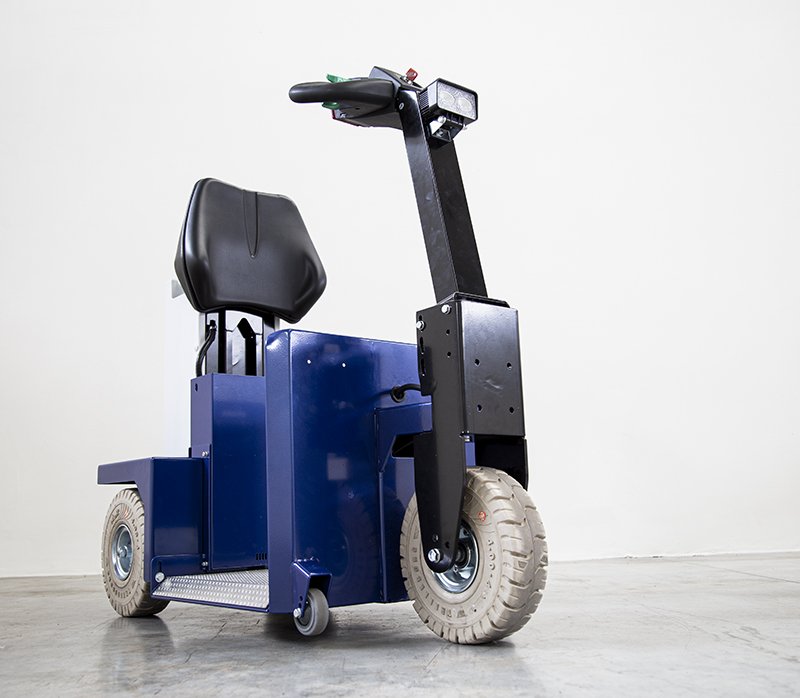
The Zallys K2 uses a 24V electrical system and offers different battery configurations.
Its published options include:
- Standard AGM battery: 30 Ah.
- AGM battery upgrades: 37 Ah or 45 Ah.
- Lithium battery upgrade: 40 Ah.
The availability of different battery configurations allows businesses to consider their operating requirements when specifying the machine.
For an Industrial Towing Application involving regular trolley transportation, battery selection should take into account the number of operating hours, travel distances, load weights and frequency of use.
For example, a facility that performs occasional trolley movements throughout the day may have different battery requirements from a distribution centre operating multiple towing cycles per shift.
When evaluating battery options, consider:
Operating frequency
How often will the electric tug be used during a typical shift? Frequent towing cycles can increase overall energy requirements.
Travel distance
Longer travel distances generally require more energy than short movements between nearby workstations.
Load conditions
Moving heavier loads can increase the energy required, particularly when acceleration and rolling resistance are significant.
Charging arrangements
Consider where the machine will be charged, how long charging periods are available and whether the charging process can be incorporated into the facility’s operating schedule.
Battery maintenance
Businesses should understand the maintenance requirements and expected service life of the selected battery type.
Lithium batteries may offer advantages in charging flexibility and battery handling, depending on the selected configuration. However, the most suitable option should be determined by comparing the actual operating requirements and total ownership costs.
A properly specified battery system helps ensure that the Industrial Towing Application can be supported throughout the working day.
6. Select the Correct Tow Hitch and Connection System
An electric tug is only as effective as its ability to connect securely with the equipment it needs to move.
Different industrial trolleys and trailers use different connection arrangements. Selecting the correct hitch is therefore an important part of specifying the Zallys K2.
The K2 offers a range of standard and customisable hook and hitch options, allowing businesses to consider different trolley configurations.
Depending on the application, possible connection arrangements include:
- Adjustable hitches for roll containers.
- Drop-pin hitches.
- Ball and pin hitches.
- Specialised connections designed for particular trolley systems.
- Customised towing attachments.
For an Industrial Towing Application involving several types of trolley, the connection system should be evaluated before purchasing the tug.
A suitable hitch should provide secure engagement, accommodate the required connection geometry and allow the operator to connect and disconnect the equipment efficiently.
It is also important to consider the turning behaviour of the complete towing combination.
When multiple trolleys are connected, their overall length and articulation can affect manoeuvrability, particularly when navigating corners or reversing.
Businesses should assess the compatibility of the selected hitch with the existing trolley fleet and confirm that the intended configuration is approved for the operating conditions.
Selecting the right connection system can help businesses integrate the electric tug into existing material-handling processes without unnecessarily changing their trolley infrastructure.
7. Consider Workplace Conditions and Operator Safety
The operating environment has a direct influence on the suitability of any powered towing equipment.
Before introducing the Zallys K2 into an Industrial Towing Application, businesses should evaluate the physical conditions of the workplace and establish appropriate operating procedures.
The K2 is advertised with non-marking wheels for indoor use, making it worth considering for facilities where maintaining floor appearance is important.
However, floor compatibility should not be assessed on wheel material alone.
Other considerations include:
- Floor surface condition.
- Floor cleanliness and contamination.
- Available traction.
- Gradients and ramps.
- Floor joints and transitions.
- Pedestrian traffic.
- Vehicle interaction.
- Visibility around corners and intersections.
The machine’s technical information also identifies safety-related features, including an emergency reverse button on the tiller head, acoustic signalling and maintained-action drive controls.
These features form part of the machine’s operating and safety design, but they do not replace appropriate workplace safety procedures.
Businesses should conduct a risk assessment before introducing powered towing equipment.
Important safety measures include:
Establish designated travel routes
Where possible, separate pedestrian movement from powered material-handling traffic.
Set suitable speed limits
Determine appropriate operating speeds for different areas of the facility.
Train operators
Ensure operators understand the controls, emergency procedures, towing limitations and correct coupling methods.
Inspect towing connections
Regularly check hooks, hitches, pins and other connection components for damage or excessive wear.
Maintain visibility
Ensure operators have a clear view of the travel path and that loads do not obstruct safe movement.
Inspect the equipment
Follow the manufacturer’s maintenance recommendations and workplace inspection procedures.
An effective Industrial Towing Application combines suitable machinery with appropriate operating procedures, operator training and ongoing equipment maintenance.
Where Can the Zallys K2 Be Used?
The Zallys K2 can be considered for a range of commercial and industrial environments where powered trolley transportation is required.
Its compact stand-on design, adjustable speed settings and towing configuration make it relevant to several material-handling applications.
Warehouse and Distribution Facilities
Warehouses regularly transport loaded trolleys between receiving areas, storage locations, picking stations and dispatch zones.
An electric tug can help consolidate repeated trolley movements into a powered transportation process.
For an Industrial Towing Application involving suitable loaded carts, the Zallys K2 may help reduce manual pushing and pulling while supporting more consistent internal material movement.
Manufacturing and Production Facilities
Manufacturing environments often require materials, components and work-in-progress products to move between different production stages.
The K2 can be considered for moving compatible trolley systems between workstations, assembly areas and temporary storage locations.
This can help establish more organised material flow and reduce the need for employees to manually transport loaded carts over repeated distances.
Supermarkets and Retail Distribution
Retail operations often involve moving stock, merchandise and replenishment supplies between storage areas and sales floors.
The Zallys K2 may be suitable for selected trolley transportation tasks where its dimensions, towing capacity and connection options match the operation.
Airports and Commercial Facilities
Large commercial facilities may require regular transportation of carts and equipment between designated service areas.
A powered tug can support these repetitive movement requirements, particularly where multiple trolley movements are part of daily operations.
In each case, the suitability of the machine depends on the combined load, route conditions, trolley compatibility and operating frequency.
Zallys K2 Technical Specifications
The following specifications provide a useful starting point when evaluating the machine for an Industrial Towing Application.
| Specification | Zallys K2 |
|---|---|
| Model | K2 |
| Manufacturer | Zallys |
| Equipment type | Stand-On Electric Tug |
| SKU | K2 |
| Motor | 24V / 800W |
| Maximum speed | 10 km/h |
| Advertised towing capacity | Up to 1,500 kg on flat ground with ballast |
| Standard battery | AGM 30 Ah |
| AGM battery upgrades | 37 Ah / 45 Ah |
| Lithium battery upgrade | 40 Ah |
| Length | 1,234 mm |
| Width | 557 mm |
| Height | 1,140 mm |
| Turning circle | 1,900 mm |
| Weight without batteries | 128 kg |
| Speed adjustment | Five-speed adjustment |
| Wheels | Non-marking wheels for indoor use |
Specifications are based on Emoveit’s published product information. The maximum towing figure is conditional on flat-ground operation with ballast. Confirm the current technical specification, available configuration and suitability for the intended application with the supplier.
Is the Zallys K2 the Right Electric Tug for Your Business?
The right electric tug should match the actual demands of the operation rather than simply provide the highest available towing capacity.
The Zallys K2 is worth considering for businesses that need a compact, stand-on electric tug for regular trolley transportation and selected medium-duty Industrial Towing Application requirements.
Its 24V/800W motor, maximum speed of 10 km/h, five-speed adjustment and range of hitch options provide features that can support different Industrial Towing Application processes.
However, businesses should assess whether the K2’s operating characteristics match their specific Industrial Towing Application needs.
The machine may be a suitable option when:
- The required towing capacity falls within its verified operating limits.
- The towing route is predominantly flat and suitable for the machine.
- The facility requires frequent movement of loaded trolleys.
- A compact stand-on design is beneficial.
- The selected hitch is compatible with the existing trolley fleet.
- The battery configuration supports the intended operating schedule.
If the Industrial Towing Application involves heavier loads, significant gradients, specialised trailers or demanding operating conditions, a different electric tug configuration may be more appropriate.
The most effective equipment selection process considers load characteristics, towing force, floor conditions, operating hours and workplace layout together.
Conclusion: Improve Your Industrial Towing Application with the Right Equipment
Selecting the right electric tug can make a meaningful difference to the way businesses manage internal material transportation.
A well-planned Industrial Towing Application can help reduce manual handling demands, improve trolley movement and support organised material flow across warehouses, manufacturing facilities and commercial workplaces.
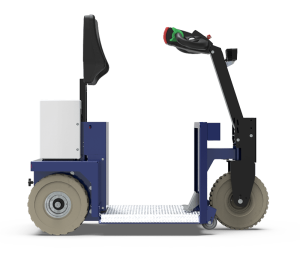
The Zallys K2 Stand-On Electric Tug offers a practical option for selected Industrial Towing Application requirements. Its 24V/800W motor, 10 km/h maximum speed, adjustable speed settings and available hitch configurations make it worth considering for businesses transporting compatible loaded trolleys.
Before choosing equipment for an Industrial Towing Application, it is important to confirm the required towing capacity, battery configuration, floor conditions and connection requirements. Matching these factors to the Industrial Towing Application will help determine whether the Zallys K2 is the right solution.
Looking for the right electric tug for your Industrial Towing Application?
Explore the Zallys K2 Stand-On Electric Tug from Emoveit.
Contact our team to discuss your towing requirements and identify an electric material-handling solution suited to your workplace.
Emoveit – Electric Tugs, Pushers and Material Handling Solutions
Phone: 1300 213 010
Email: sales@emoveit.com.au
Website: https://emoveit.com.au/