



Walk-Behind vs Ride-On Electric Tugs: Which Configuration Suits Your Workplace?
Moving heavy loads across warehouses, manufacturing facilities and distribution centres is a regular part of industrial operations. Whether transporting equipment, towing loaded trolleys or moving materials between workstations, businesses need reliable equipment that can improve transport efficiency while reducing the physical demands placed on employees.
Traditional manual handling methods can become inefficient when loads need to be moved repeatedly over long distances or across large work areas. Pushing and pulling heavily loaded carts can require considerable physical effort, particularly when employees perform these tasks throughout their shifts. This is where electric towing equipment can make a significant difference.
Electric tugs provide powered assistance for moving loads, helping businesses reduce reliance on manual pushing and pulling. However, not all electric tugs are designed for the same working conditions. Two common configurations are walk-behind electric tugs and ride-on electric tugs.
Both configurations offer practical advantages, but choosing the right one depends on the type of loads being transported, the distance travelled, available workspace and frequency of operation.
Ride-On Electric Tugs are particularly useful for workplaces that regularly move loads across longer distances or require operators to travel between different work areas. Instead of walking behind the equipment, operators travel on the machine, controlling the towing movement from a seated position.
Walk-behind models, on the other hand, are often better suited to shorter movements, confined spaces and applications where operators need to remain close to the load.
Understanding the differences between these configurations can help businesses select equipment that supports safer handling practices, improves workflow and meets their operational requirements.
In this guide, we compare walk-behind and ride-on electric tugs, examine their advantages and applications, and explain how to determine which configuration is best suited to your workplace.
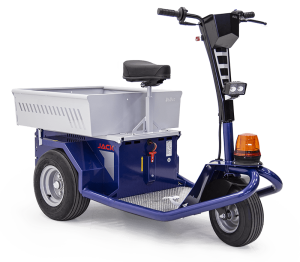
1. What Are Walk-Behind Electric Tugs?
Walk-behind electric tugs are powered material-handling machines operated by a person walking alongside or behind the equipment. They are designed to assist with pushing or pulling loads that would otherwise require considerable manual effort.
These machines use an electric drive system to provide controlled movement, allowing operators to manoeuvre connected carts, trolleys, trailers and other compatible loads.
Unlike manually operated trolleys, walk-behind electric tugs provide powered assistance to help reduce the physical effort involved in moving heavy equipment.
How Walk-Behind Electric Tugs Work
An operator controls the machine using a handle, tiller or control panel, depending on the model. The electric motor drives the wheels, while an appropriate towing connection transfers the pulling force to the load.
The operator remains on foot and guides the machine along the intended route.
Walk-behind electric tugs are generally designed for applications where operators need direct control over the equipment and frequent access to the load or surrounding workspace.
Key Advantages of Walk-Behind Electric Tugs
1. Manoeuvrability in Confined Spaces
Walk-behind equipment can be useful in areas where turning space is limited. Operators can guide the machine through narrow aisles, smaller workstations and restricted access points, depending on the equipment dimensions and load configuration.
2. Direct Operator Control
Because the operator walks alongside the equipment, they can maintain close awareness of the load, towing connection and surrounding environment.
This can be beneficial when handling smaller loads or performing tasks that require frequent adjustments.
3. Suitable for Short-Distance Transport
Walk-behind electric tugs are practical for moving equipment between nearby workstations, storage areas and production lines.
For workplaces where loads travel relatively short distances, a walk-behind configuration may provide sufficient powered assistance without requiring a ride-on machine.
4. Flexible Workplace Applications
Depending on the model and towing capacity, walk-behind electric tugs can support different material-handling requirements, including moving industrial carts, waste containers, equipment trolleys and specialised transport units.
When Should You Consider a Walk-Behind Model?
A walk-behind electric tug may be appropriate when:
- Loads are transported over relatively short distances.
- Operators need to work closely with the load.
- Available manoeuvring space is limited.
- Towing requirements are within the machine’s rated capacity.
- Transport activities are intermittent rather than continuous.
- A compact pedestrian-operated solution is preferred.
However, if employees regularly walk long distances while controlling towing equipment, a ride-on configuration may offer greater operational convenience.
2. What Are Ride-On Electric Tugs?
Ride-on electric tugs are powered towing machines that allow operators to travel on the equipment while moving connected loads.
Instead of walking behind the machine, the operator sits or stands on a designated operating platform, depending on the configuration. This allows them to control the vehicle while travelling between different locations within the facility.
Ride-On Electric Tugs are designed for applications where repeated transport activities, longer travel distances or frequent towing movements make pedestrian operation less practical.
These machines are commonly considered for warehouses, manufacturing plants, logistics facilities, distribution centres and other industrial environments.
How Ride-On Electric Tugs Work
A ride-on electric tug uses an electric motor, battery system, drive wheels and steering controls to move the vehicle.
The operator controls the direction and speed of travel while the connected load follows behind through a compatible towing hitch or coupling.
The machine provides the traction needed to move the load, reducing the need for employees to manually push or pull heavy carts.
Depending on the model, ride-on electric tugs may offer adjustable speed settings, operator protection features, different towing capacities and interchangeable towing connections.
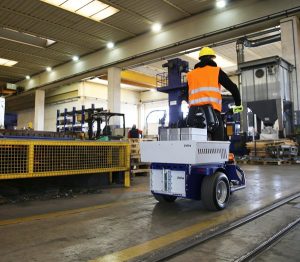
Key Advantages of Ride-On Electric Tugs
1. Reduced Walking During Repetitive Transport
One of the main advantages of Ride-On Electric Tugs is that operators travel with the machine rather than walking behind it.
This can be particularly useful in facilities where employees repeatedly move loads between distant workstations, production areas and storage locations.
2. Improved Transport Efficiency
When loads need to travel across large facilities, a ride-on machine can help streamline the movement process.
Operators can travel between designated locations without having to walk the entire route while controlling the equipment.
This may help improve the consistency of repetitive transport activities and support more organised material-handling workflows.
3. Suitable for Longer Travel Distances
Ride-on electric tugs are particularly relevant when towing activities involve long internal routes, multiple departments or frequent movements between loading and unloading areas.
Their operating configuration is designed to support these transport requirements.
4. Support for Higher Towing Requirements
Depending on the model, Ride-On Electric Tugs can be configured for different towing capacities.
This makes them suitable for workplaces that need to move multiple connected carts or heavier industrial equipment, provided the combined load, towing force and operating conditions remain within the manufacturer’s specifications.
5. Operator Convenience
A seated operating position can provide a more convenient working arrangement during repeated transport tasks.
Rather than continuously walking behind the machine, operators control the equipment from its designated riding position.
The suitability of a particular model will depend on its ergonomics, controls, visibility and operating environment.
3. Walk-Behind vs Ride-On Electric Tugs: Key Differences
Although both configurations provide powered assistance for towing, their operating characteristics differ.
Understanding these differences can help businesses identify which equipment is more appropriate for their material-handling processes.
Operator Position and Movement
The most noticeable difference is how the operator interacts with the machine.
Walk-behind electric tugs require the operator to remain on foot and guide the equipment using its handle or control system.
Ride-On Electric Tugs allow the operator to travel on the machine, either seated or standing, depending on the design.
For repetitive movements across large facilities, a ride-on configuration may reduce the amount of walking required during transport operations.
For shorter movements requiring close interaction with the load, walk-behind equipment may be more practical.
Transport Distance
Travel distance is another important consideration.
Walk-behind models are commonly suited to shorter routes, particularly when loads move between nearby workstations or storage areas.
Ride-On Electric Tugs are often better suited to longer routes where operators need to travel repeatedly between different parts of a facility.
However, actual suitability also depends on battery capacity, operating time, floor conditions, load weight and the manufacturer’s recommended operating limits.
Towing Capacity
Towing capacity varies considerably between electric tug models.
Some walk-behind machines are designed for relatively light-duty applications, while specialised pedestrian tugs can handle substantial towing requirements.
Similarly, Ride-On Electric Tugs are available in different capacities to accommodate varying industrial loads.
Businesses should consider the total loaded weight of the carts or trailers, the number of units being towed and the conditions under which the equipment will operate.
It is also important to distinguish between towing capacity and carrying capacity. These are not interchangeable specifications.
Manoeuvrability
Walk-behind electric tugs can provide good control in confined areas because operators remain close to the machine.
Ride-on equipment requires sufficient space for the vehicle, operator and connected load to turn safely.
However, compact Ride-On Electric Tugs can still be suitable for facilities with restricted access when their turning radius and overall dimensions match the available workspace.
Frequency of Use
For occasional towing tasks, a walk-behind model may be a suitable and practical solution.
For frequent transport operations involving multiple trips throughout the working day, Ride-On Electric Tugs may offer a more appropriate operating configuration.
The decision should consider how often employees move loads, how far they travel and how much time is spent on repetitive towing activities.
Comparison Table
| Consideration | Walk-Behind Electric Tugs | Ride-On Electric Tugs |
|---|---|---|
| Operator position | Walking beside or behind the machine | Seated or standing on the machine |
| Travel distance | Generally suited to shorter routes | Well suited to longer routes |
| Operator movement | Operator walks during transport | Operator travels with the machine |
| Manoeuvrability | Useful in confined work areas | Requires suitable turning clearance |
| Towing capacity | Varies by model | Varies by model |
| Transport frequency | Occasional or regular short movements | Frequent or repetitive transport |
| Typical applications | Workstations, smaller storage areas and short-distance towing | Warehouses, manufacturing and distribution facilities |
| Main consideration | Close control and compact operation | Transport efficiency and operator convenience |
Neither configuration is automatically better for every workplace. The right choice depends on the operating requirements rather than the machine type alone.
4. When Should You Choose Ride-On Electric Tugs?
For businesses with frequent material-handling requirements, Ride-On Electric Tugs can provide practical advantages over pedestrian-operated equipment.
The decision becomes particularly relevant when employees spend a significant part of their working day moving carts, trailers and industrial equipment across large facilities.
Consider the following workplace situations.
Large Warehouses and Distribution Centres
Warehouses often involve the movement of goods between receiving areas, storage locations, picking zones and dispatch areas.
Employees may need to transport several loaded carts throughout the facility, sometimes over considerable distances.
Ride-On Electric Tugs can help support these movements by allowing operators to travel with the towing machine.
This can be particularly useful when moving multiple compatible carts along designated transport routes.
Manufacturing Facilities
Manufacturing environments frequently require materials, components and equipment to move between production stations.
A ride-on tug can support internal logistics by transporting loaded trolleys between departments, assembly areas and storage locations.
For facilities with repetitive material transfers, Ride-On Electric Tugs can help establish more consistent transport processes.
Logistics and Loading Areas
Loading and unloading activities often involve moving equipment between staging areas, storage zones and vehicle access points.
A ride-on electric tug may be useful when compatible trailers or carts need to be moved regularly across larger operational areas.
The towing connection, available turning space and surface conditions should be assessed before selecting the equipment.
Industrial Maintenance Operations
Maintenance teams may need to transport tools, spare parts and equipment between different areas of a facility.
Ride-on machines can assist with these movements, particularly when maintenance activities cover extensive industrial sites.
They can also support the movement of compatible service carts and equipment trailers.
Facilities with Repetitive Towing Tasks
When employees repeatedly move the same types of loads throughout their shifts, the equipment configuration becomes an important consideration.
Ride-On Electric Tugs can reduce the need for operators to walk behind the machine during every transport movement.
This may improve the practicality of repetitive towing activities and help businesses organise internal transport more efficiently.
5. How Ride-On Electric Tugs Can Support Workplace Safety
Manual handling is an important consideration in industrial workplaces.
Employees who regularly push or pull heavy carts, equipment and trailers may be exposed to physical demands associated with hazardous manual tasks.
These demands can include repetitive force, sustained exertion, awkward postures and repetitive movements.
Electric towing equipment can help reduce reliance on manual pushing and pulling by providing powered assistance.
However, selecting the right machine is only one part of an effective workplace safety strategy.
Reducing Manual Pushing and Pulling
Moving heavily loaded carts manually can require considerable effort, especially over longer distances.
Ride-On Electric Tugs provide powered traction to move compatible loads, reducing the need for employees to generate the pulling force themselves.
This can help businesses address some of the physical demands associated with repetitive load transport.
Supporting More Consistent Load Movement
Powered towing equipment provides controlled movement compared with manually pushing or pulling heavy equipment.
Operators can use the machine’s controls to manage movement and follow designated transport routes.
Appropriate speed settings and compatible towing connections are important for maintaining control.
Improving Operator Positioning
Ride-On Electric Tugs allow operators to travel in a designated seated or standing position rather than continuously walking behind the equipment.
This changes the physical demands of the task and may be more appropriate for repetitive transport over longer distances.
The operator’s position should still provide adequate visibility and access to the controls.
Reducing Exposure to Repetitive Transport Demands
In workplaces where employees perform frequent towing movements, introducing powered equipment can help reduce the physical effort associated with these tasks.
Businesses should assess the complete task, including loading, unloading, coupling, uncoupling and pedestrian interaction.
A suitable electric tug should form part of a broader risk-control approach rather than being treated as a complete replacement for workplace safety procedures.
6. Important Factors to Consider Before Choosing an Electric Tug
Before purchasing walk-behind or ride-on equipment, businesses should evaluate their actual transport requirements.
The following considerations can help determine which configuration is most suitable.
1. Total Towing Weight
Start by identifying the maximum weight that needs to be moved.
Consider the combined weight of the loaded carts or trailers rather than calculating the load of an individual trolley.
The towing capacity specified by the manufacturer should be checked against the actual operating conditions.
Remember that towing performance can be affected by gradients, floor surfaces, wheel types, ballast and the configuration of the trailer.
2. Travel Distance
Measure the distance between the main loading, storage, production and dispatch areas.
If employees regularly travel long distances, Ride-On Electric Tugs may provide a more convenient solution.
For shorter routes, a walk-behind model may be sufficient.
3. Workplace Layout
Consider aisle widths, turning areas, doorways, pedestrian walkways and access points.
A ride-on machine needs adequate clearance for both the vehicle and its connected load.
Check the machine’s dimensions and turning circle against the available operating space.
4. Frequency of Transport
Evaluate how often loads need to be moved throughout the day.
A workplace that performs several towing movements per shift may have different equipment requirements from a facility that only moves occasional loads.
Ride-On Electric Tugs are worth considering when towing is a regular part of daily operations.
5. Floor and Ground Conditions
Floor surfaces can affect towing performance.
Smooth concrete, uneven surfaces, ramps and outdoor pathways may require different wheel configurations and machine specifications.
Check whether the equipment is designed for indoor use, outdoor operation or both.
6. Battery Capacity and Operating Time
Battery performance should match the expected operating schedule.
Consider the number of trips, travel distances, load weights and charging opportunities available during the working day.
The selected machine should have sufficient operating capability for the intended application.
7. Towing Connections and Accessories
The towing hitch or coupling must be compatible with the carts, trailers or equipment being moved.
Some applications require specialised connections, customised attachments or additional accessories.
Confirm that the machine can be configured to suit the equipment already used in your workplace.
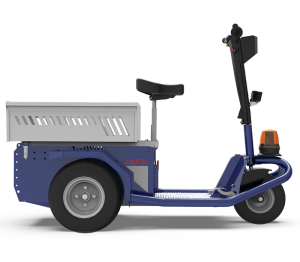
7. Introducing the Zallys JACK Seat-On Electric Tow Tractor
For businesses considering Ride-On Electric Tugs, the Zallys JACK Seat-On Electric Tow Tractor is one option worth examining.
Available through Emoveit, the JACK is designed for industrial logistics applications where powered towing can help eliminate manual handling of loads and improve movement efficiency.
Its compact design and seated operating configuration make it suitable for businesses that need a practical towing solution for internal transport activities.
Key Features of the Zallys JACK
Towing Capacity Options
The Zallys JACK product listing identifies towing capacity options of 500 kg, 1,500 kg and 2,500 kg.
The appropriate configuration should be selected according to the actual towing requirements and operating conditions. Confirm the applicable rating and upgrade configuration with Emoveit before specifying the machine.
24V / 1,000W Electric Motor
The JACK uses a 24V / 1,000W electric motor to provide powered movement for industrial towing applications.
Its electric drive system supports controlled transport without relying on manual pushing or pulling.
Maximum Forward Speed of 10 km/h
The standard version has a maximum forward speed of 10 km/h, with an available upgraded configuration listed at up to 12 km/h.
A speed adjustment button and five-speed selector provide additional control over operating speed.
Actual operating speed should always be appropriate for the load, route, visibility and workplace conditions.
Compact Design and Narrow Turning Radius
The JACK has a listed length of 1,600 mm and width of 814 mm, with a turning circle of 2,300 mm.
These dimensions make it worth considering for industrial environments where manoeuvrability is important.
Pneumatic Wheels for Indoor and Outdoor Use
The machine features pneumatic wheels designed to support operation on suitable indoor and outdoor surfaces.
This provides flexibility for businesses that need to move loads across different areas of their facilities.
Standard and Customisable Towing Accessories
The JACK offers a range of standard towing accessories, with customised options available on request.
This allows businesses to consider different hitch arrangements depending on the carts, trailers and equipment they need to move.
Zallys JACK Technical Specifications
| Specification | Details |
|---|---|
| Product | Zallys JACK Seat-On Electric Tow Tractor |
| Motor | 24V / 1,000W |
| Standard maximum forward speed | 10 km/h |
| Upgraded maximum forward speed | 12 km/h |
| Listed towing capacity options | 500 kg, 1,500 kg and 2,500 kg |
| Maximum load capacity on flat ground | 500 kg |
| Dimensions | 1,600 mm L × 814 mm W |
| Turning circle | 2,300 mm |
| Wheels | Pneumatic |
| Applications | Industrial towing and internal logistics |
Note: The manufacturer’s technical information distinguishes between the standard and upgraded towing configurations. Towing capacity in kilograms can also vary with ground conditions, ballast and wheel selection. The maximum 500 kg carrying capacity is separate from the towing rating.
Why Consider the Zallys JACK for Industrial Transport?
The Zallys JACK is particularly relevant to businesses that need a seated towing machine for regular internal transport.
Its combination of a compact design, adjustable speed and different towing configurations makes it suitable for consideration across several industrial applications.
For example, a warehouse may use the machine to move loaded carts between storage and dispatch areas. A manufacturing facility may use it to transport components between production stations. A maintenance department may use compatible trailers to move tools and equipment around a larger site.
Rather than relying on employees to manually pull heavy loads, businesses can use the JACK to provide powered towing assistance.
For organisations evaluating Ride-On Electric Tugs, it offers a practical example of how a seated electric towing configuration can support industrial material movement.
View the Zallys JACK Seat-On Electric Tow Tractor for further product information.
8. Common Applications for Ride-On Electric Tugs
The versatility of Ride-On Electric Tugs makes them relevant to several industries where internal transportation is an important part of daily operations.
Warehousing and Distribution
Warehouses can use ride-on tugs to move loaded carts, equipment trailers and other compatible transport units between different operational areas.
This can support internal logistics and help reduce repetitive manual towing tasks.
Manufacturing and Assembly
Production facilities often need a consistent supply of components, tools and materials at different workstations.
Ride-on tugs can help transport compatible carts between production areas and storage locations.
Automotive and Engineering Workshops
Automotive facilities and engineering workshops may need to move equipment, parts and specialised carts between work areas.
A suitable ride-on tug can assist with these movements where the load and towing connection are compatible.
Airports and Large Commercial Facilities
Large facilities may involve extensive internal transport routes and frequent movement of equipment.
Depending on the machine’s rated capacity and operating environment, Ride-On Electric Tugs can support the movement of compatible carts and trailers.
Industrial Maintenance and Service Operations
Maintenance teams can use powered towing equipment to move tools, spare parts and service equipment across large operational sites.
A ride-on configuration may be useful when these movements occur frequently throughout the day.
9. Common Mistakes to Avoid When Selecting an Electric Tug
Choosing the wrong electric tug configuration can affect operational efficiency, equipment suitability and workplace safety.
Before making a decision, avoid these common mistakes.
Choosing Equipment Based Only on Towing Capacity
A high towing capacity does not automatically mean a machine is suitable for every application.
Consider the actual towing force, ground conditions, trailer configuration, turning requirements and operating environment.
Ignoring the Travel Distance
A walk-behind machine may be adequate for short movements but less convenient for repetitive long-distance transport.
Evaluate how much walking and travel is involved in the task before choosing between configurations.
Overlooking Workplace Dimensions
A ride-on tug may require more clearance than a pedestrian-operated model.
Check the dimensions of the machine and connected load against the available aisle widths, doorways and turning areas.
Using Incompatible Towing Connections
The hitch must securely connect the tug to the equipment being moved.
Check the required coupling type and whether standard or customised accessories are necessary.
Not Considering Operator Training
Employees must understand how to operate the equipment safely.
Training should cover speed control, steering, towing connections, load limits, pedestrian awareness and operating procedures.
Assuming All Ride-On Electric Tugs Have the Same Performance
Different models have different towing ratings, battery systems, dimensions, speed settings and operating capabilities.
Compare the specifications of each machine against your actual workplace requirements rather than relying on general equipment categories.
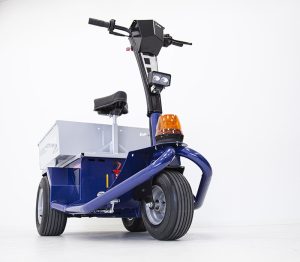
10. How to Determine Which Configuration Suits Your Workplace
The choice between walk-behind and ride-on electric tugs should begin with a practical assessment of your current material-handling activities.
Consider the following questions:
- How heavy are the loads being transported?
- How far do employees need to travel?
- How frequently are towing tasks performed?
- Are loads moved individually or in connected groups?
- Does the facility have narrow aisles or restricted turning areas?
- Are transport routes indoors, outdoors or across both environments?
- Would a seated operating position improve the practicality of repetitive transport?
- What towing accessories are required?
If your business mainly performs short-distance movements in restricted areas, a walk-behind electric tug may be the more suitable option.
However, if employees regularly transport loads across large facilities, Ride-On Electric Tugs may provide a more appropriate solution.
For businesses with mixed requirements, it may also be worth considering whether different configurations are needed for separate transport tasks.
The objective should be to select equipment that matches the actual load, route and frequency of operation.
Conclusion: Choosing the Right Electric Tug for Your Workplace
Both walk-behind and ride-on electric tugs can improve industrial load movement by providing powered assistance and reducing reliance on manual pushing and pulling.
Walk-behind models are useful for shorter-distance transport, confined spaces and applications requiring close operator control.
Ride-On Electric Tugs, on the other hand, are particularly relevant to businesses that regularly move loads across longer distances or perform repetitive internal transport activities.
For warehouses, manufacturing facilities and distribution centres, selecting the appropriate ride-on configuration can help support more organised material movement and improve the practicality of daily towing operations.
The Zallys JACK Seat-On Electric Tow Tractor is one option for businesses looking to introduce a compact, seated electric towing solution. With its 24V / 1,000W motor, pneumatic wheels, speed adjustment and available towing configurations, it is designed to support a range of industrial logistics requirements.
Ultimately, the best configuration will depend on your load requirements, workplace layout, travel distances and operating frequency.
If you are comparing Ride-On Electric Tugs for your facility, Emoveit can help you identify a suitable towing solution based on your application.
Contact Emoveit to discuss your industrial towing requirements and find out more about the Zallys JACK Seat-On Electric Tow Tractor.
Phone: 1300 213 010
Email: sales@emoveit.com.au
Website: https://emoveit.com.au/