



Can Electric Lifting Equipment Reduce Musculoskeletal Injuries?
Musculoskeletal injuries are a significant concern in workplaces where employees regularly lift, lower and position heavy or awkward loads. Repeated manual handling can strain the back, shoulders, arms and joints, particularly when workers maintain uncomfortable postures or apply sudden force.
For warehouses, workshops, manufacturing facilities and maintenance operations, reducing physical demands is essential for improving workplace safety. One practical approach is using Electric Lifting Equipment to reduce reliance on manual lifting and positioning.
Electric Lifting Equipment can help reduce musculoskeletal injury risks by transferring much of the physical effort involved in lifting loads to a mechanical system. However, equipment selection, workplace layout, operator training and safe operating procedures remain important.
A practical example is the Just Lift JL250 Hydraulic Mini-Crane available through Emoveit. Designed to handle loads of up to 250 kg under specified operating conditions, this compact lifting solution combines battery-powered movement, hydraulic lifting and arm extension, and 270-degree rotation. These features support suitable lifting tasks that might otherwise require considerable manual effort.
This article explores how Electric Lifting Equipment can support musculoskeletal injury prevention, which workplace tasks may benefit, and what businesses should consider when selecting Electric Lifting Equipment for safer material handling.
What Are Musculoskeletal Injuries?
Musculoskeletal disorders (MSDs) affect the muscles, tendons, ligaments, joints, nerves, bones and other connective tissues. They can develop suddenly following strenuous activity or gradually through repeated exposure to physical demands at work.
Common examples include:
- Lower-back pain, strains and other back injuries.
- Shoulder injuries from lifting, reaching and handling loads.
- Muscle and tendon strains caused by repetitive exertion.
- Wrist and elbow disorders associated with forceful or repetitive movements.
- Joint injuries resulting from awkward postures.
- Soft-tissue injuries, including hernias associated with strenuous exertion.
According to Safe Work Australia, hazardous manual tasks can involve repetitive movement, sustained or sudden force, awkward postures and vibration. These factors can combine to increase physical strain.
In industrial environments, manual handling risks are not limited to exceptionally heavy loads. Repeatedly handling moderately weighted components, moving equipment through restricted spaces or positioning loads at uncomfortable heights can also create injury risks.
Task frequency, load distance, grip requirements and worker posture all influence the level of risk. Electric Lifting Equipment can help reduce physical demands during suitable lifting tasks, particularly when manual handling involves repetitive exertion or awkward positioning.
For this reason, businesses should assess the complete handling process and consider Electric Lifting Equipment as part of a broader strategy to improve workplace ergonomics and reduce musculoskeletal injury risks.
Why Does Manual Handling Increase Injury Risk?
Manual handling becomes hazardous when the physical demands of a task exceed what can be performed safely and consistently. Several common workplace activities can contribute to this problem.
1. Repeated lifting and lowering
Employees who repeatedly transfer equipment between pallets, workbenches, storage areas and production machinery may experience cumulative physical strain.
Even when each individual lift appears manageable, repeated exertion can fatigue muscles and reduce a worker’s ability to maintain good posture throughout a shift.
A mechanical lifting aid can reduce the need to support the load manually during these transfers.
2. Awkward working positions
Lifting from floor level, reaching across a machine or positioning a component inside a confined assembly area can place additional stress on the body.
Twisting while carrying a load is particularly concerning because the worker must control the weight while maintaining an unnatural position.
Appropriately selected lifting equipment can help bring a load to a more accessible position and support controlled movement during installation or removal.
3. High physical force
Some loads require substantial force to lift, stabilise or position. This can be especially challenging when the item has an uneven shape, limited gripping points or a centre of gravity that makes it difficult to control.
A lifting system can carry the load’s weight, reducing the physical force workers need to apply directly.
However, workers may still need to guide the load, attach lifting accessories and control its movement. These activities must also be considered during risk assessments.
4. Unexpected load movement
Loads can shift when they are lifted incorrectly, inadequately secured or moved through restricted spaces. Workers may instinctively attempt to catch or stabilise a shifting object, potentially exposing themselves to sudden forces.
Mechanical lifting equipment can support more controlled handling when the load is properly attached and the equipment is operated within its specified limits.
It does not eliminate the risk of dropped or unstable loads, so suitable lifting accessories, load assessment and exclusion zones remain essential.
5. Fatigue during repetitive work
Physically demanding tasks can become more difficult as a shift progresses. Fatigue may affect coordination, posture and the ability to control a load.
Reducing repeated manual lifting can help limit this source of physical demand. It should form part of a broader strategy that considers work scheduling, task rotation, workstation design and appropriate recovery periods.
How Can Electric Lifting Equipment Reduce Musculoskeletal Injury Risks?
Electric lifting equipment can change the way a workplace handles heavy and awkward objects. Instead of relying primarily on a worker’s strength to raise, lower or position a load, the equipment performs much of the lifting work.
The benefits depend on the task and the equipment selected, but several mechanisms are particularly relevant to injury prevention.
1. Reducing physical lifting effort
The most direct benefit is reducing the force employees must exert to raise a load.
When workers manually lift equipment, they must generate enough force to overcome its weight while maintaining control throughout the movement. This can place substantial demands on the back, shoulders, arms and other parts of the musculoskeletal system.
A powered or hydraulically assisted lifting system supports the load during the lifting process. Workers can concentrate on positioning, monitoring and controlling the operation instead of physically raising the full weight themselves.
For example, the Just Lift JL250 Hydraulic Mini-Crane is designed to handle loads of up to 250 kg under the specified operating conditions. Its hydraulic lifting and arm-extension functions provide a mechanical alternative to manually raising and positioning compatible loads.
2. Minimising repeated strenuous movements
Repetitive lifting can expose employees to recurring physical stress throughout a shift. This is particularly relevant in workshops and maintenance departments where components may need to be removed, inspected, repaired and reinstalled.
Using a lifting aid for suitable tasks can reduce the number of times workers must physically raise or support these components.
Over time, this may help reduce cumulative exposure to strenuous manual handling. It can also make a handling procedure more consistent because the lifting system provides a repeatable method of raising and positioning loads.
Businesses should assess the entire workflow, however. If employees still need to manually lift components onto the lifting device, move them across long distances or repeatedly reach into awkward spaces, some of the original risks may remain.
3. Supporting better working postures
An important part of injury prevention is designing work so that employees do not have to bend, twist or reach excessively.
A suitable lifting crane can help position a load at an accessible height or move it into a suitable working area. This may reduce the need for employees to hold heavy components while adjusting their position.
The JL250’s hydraulic arm extension and 270-degree rotation capability can support load positioning across a range of suitable working positions. Its rotation mechanism uses a steel turntable ball bearing, with locking positions at 45-degree intervals.
Nevertheless, rotation alone does not guarantee an ergonomic outcome. The crane must be positioned correctly, and workers should not need to twist their bodies, reach beneath suspended loads or place themselves between the load and a fixed object.
4. Reducing the need for improvised lifting methods
When suitable lifting equipment is unavailable, workers may improvise by using multiple people, makeshift supports or unsuitable tools.
These approaches can create additional hazards, particularly when workers have limited visibility, cannot coordinate their movements or lack a reliable way to control the load.
Providing equipment suited to the task establishes a more consistent handling method. A defined lifting procedure can specify how the load is attached, which capacity limit applies, where workers should stand and how the load is positioned.
This helps move injury prevention away from reliance on individual strength and judgement towards a planned, repeatable process.
5. Supporting more consistent material handling
A properly selected mechanical lifting aid can also help standardise tasks that would otherwise vary considerably between employees.
For example, maintenance teams may need to remove similar components from several machines. A suitable crane can provide a consistent means of lifting and positioning those components, provided each task falls within the equipment’s operating limits.
Consistency can make it easier for supervisors to establish safe work procedures, identify hazards and train employees.
However, a standard procedure must still account for differences in load shape, attachment points, centre of gravity and access conditions. A lifting method that is suitable for one component may not be appropriate for another.
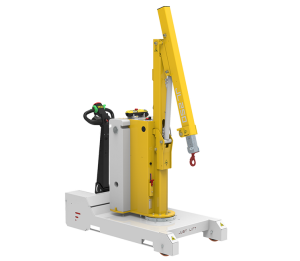
Introducing the Just Lift JL250 Hydraulic Mini-Crane
Battery-powered, counterbalanced hydraulic mini-crane
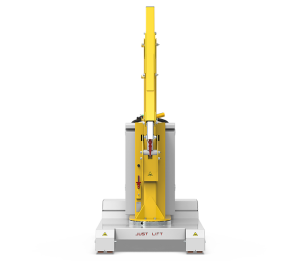
The JL250 is designed to simplify the lifting and handling of loads in industrial and logistical environments. Its compact dimensions make it suitable for consideration in work areas where larger lifting equipment may be difficult to position.
-
Maximum rated lifting capacity: 250 kg
-
Hydraulic lifting and arm extension
-
Battery-powered operation
-
Electric tiller driving system
-
270-degree rotation
-
Standard anti-tipping system
Source: Emoveit product specifications.
The JL250 provides an example of how a compact lifting solution can support safer material handling when manual lifting is a recurring concern.
Its key features are relevant to different aspects of a workplace handling task.
Battery-powered movement
The JL250 uses a battery power supply and an electric tiller driving system. This allows the crane to be moved using its powered driving arrangement rather than relying solely on manually pushing the entire machine.
The product specifications list a weight of 610 kg without batteries and 680 kg with batteries.
Hydraulic lifting and arm extension
The JL250 uses hydraulic mechanisms for lifting and extending its arm. This enables the equipment to support the load during raising and positioning rather than requiring the operator to lift it physically.
For tasks involving compatible machinery components, tools or other suitable loads, this can reduce the physical demands associated with manual elevation and positioning.
The precise suitability of a task depends on the load’s dimensions, lifting points, centre of gravity and required reach.
Compact dimensions for restricted work areas
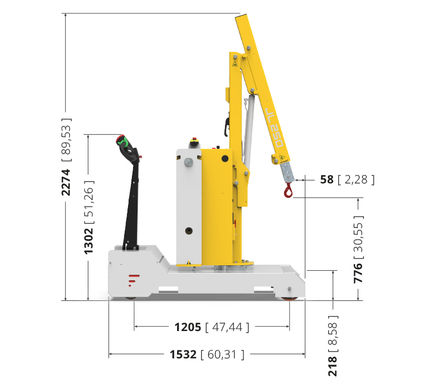
The published dimensions are approximately 1,840 mm long and 780 mm wide, with a steering diameter of 1,050 mm. The total height is listed as 2,310 mm.
A narrow machine footprint may be useful in some workshops or maintenance spaces, but the complete operating envelope must be considered. This includes the arm’s movement, the load’s dimensions, turning clearance, overhead obstructions and safe access for the operator.
Controlled rotation
The crane’s 270-degree rotation capability can support positioning from different directions. The turntable mechanism includes locking positions at 45-degree intervals.
The rotation system should still be used within the manufacturer’s operating instructions, with adequate clearance and control of the suspended load.
Understanding the JL250’s Lifting Capacity
A crane’s maximum rated capacity should never be treated as a universal limit that applies regardless of arm position.
The JL250’s published capacities are:
| Arm extension position | Maximum stated capacity |
|---|---|
|
First position |
250 kg |
|
Second position |
160 kg |
| Third position, using the additional extension |
130 kg |
These figures apply under the product page’s stated conditions: flat ground with a 0% slope and the arm parallel to the floor. The third position requires an additional extension that is added manually.
If a load exceeds the permissible capacity for the selected configuration, the crane may become unstable or the lifting operation may become unsafe. Workers must therefore confirm the correct rated capacity for the actual arm position rather than relying on the headline figure of 250 kg.
The load must also be compatible with the lifting attachment and properly secured. The manufacturer’s instructions, applicable rated-capacity information and any required workplace procedures should be followed.
Mechanical assistance reduces certain physical demands, but incorrect equipment use can introduce serious crush, impact, dropped-load and stability hazards.
Which Workplace Tasks May Benefit from Electric Lifting Equipment?
Electric and hydraulically assisted lifting equipment can be useful in workplaces where employees regularly handle loads that are heavy, awkward or difficult to position manually.
The following examples illustrate potential applications. Each task requires a site-specific assessment to confirm that the JL250 or another lifting solution is suitable.
Workshop maintenance and equipment servicing
Maintenance teams often remove motors, gearboxes, pumps and other components for inspection or replacement. These items can be difficult to grip and may need to be raised or aligned precisely.
A suitable mini-crane can support the component while it is removed or positioned, reducing the need for employees to hold its weight manually.
Manufacturing and assembly operations
Production environments may require components to be transferred between workstations, fixtures and machinery.
Where loads are compatible with the crane’s capacity and reach, mechanical lifting can reduce strenuous handling and help workers position components more consistently.
Warehousing and equipment handling
Some warehouse tasks involve handling machinery parts, packaged equipment or other items that cannot be moved conveniently using standard trolleys.
A compact crane may provide a useful option for lifting and positioning specific items, particularly where a suitable forklift or larger crane is impractical for the task.
However, it should not be assumed that a mini-crane can replace equipment designed for pallet handling or general goods transportation.
Installation and repair work
During equipment installation, workers may need to align components with mounting points or machinery interfaces.
A suitable lifting aid can support the load while its position is adjusted, potentially reducing the need for workers to support awkward weights while trying to achieve precise alignment.
The work procedure should prevent hands and other body parts from entering pinch points during final positioning.
Electric Lifting Equipment Is Only One Part of Injury Prevention
Introducing a lifting crane does not automatically eliminate musculoskeletal injury risks. Safe Work Australia recommends identifying hazardous manual tasks, assessing their risks and applying appropriate controls, prioritising elimination where reasonably practicable. Mechanical aids are one option when hazardous handling cannot be eliminated.
Conduct a manual handling risk assessment
Identify tasks that involve repetitive lifting, high force, awkward postures or unexpected load movement.
Assess the load’s weight and dimensions, the frequency of handling, the available space, the required lifting height and the amount of manual force workers must still apply.
Involve employees who perform the tasks because they can often identify difficulties that are not apparent from observing the equipment alone.
Select equipment for the actual task
Confirm the rated capacity at the required reach, the lifting attachment, available clearance and the floor conditions.
For the JL250, this includes accounting for the different capacities associated with each arm-extension position.
If the task requires lifting above the crane’s capacity or reaching beyond its permitted operating envelope, select a more suitable solution rather than attempting to adapt the equipment.
Train operators and establish procedures
Operators should understand the equipment’s controls, operating limits, stability requirements and emergency procedures.
Training should also cover load attachment, pre-use checks, safe positioning and the need to keep people clear of suspended loads.
Only authorised, trained personnel should operate the equipment in accordance with the manufacturer’s instructions and applicable workplace requirements.
Maintain the equipment
Routine inspections and scheduled maintenance help identify defects that could compromise safe operation.
Check the lifting mechanism, controls, brakes, wheels, battery system, chains and attachments as applicable to the equipment and its maintenance instructions. Remove defective equipment from service until it has been assessed and repaired appropriately.
Review the results
After introducing a lifting aid, review whether the original hazards have actually been reduced.
Consider worker feedback, observed postures, the amount of manual force still required, handling times and any reported discomfort or near misses.
If workers continue to lift loads manually before or after using the crane, the process may need further redesign.
How Can Businesses Measure the Benefits?
Businesses can evaluate whether Electric Lifting Equipment improves manual handling by establishing a baseline before implementation.
Useful indicators include:
- Manual lifting frequency: Record how often workers physically raise or support loads.
- Physical effort: Assess pushing, pulling, gripping and stabilising demands.
- Task ergonomics: Observe bending, twisting and awkward reaching.
- Handling consistency: Check whether loads can be moved and positioned safely and consistently.
- Safety observations: Track handling-related incidents, near misses and reports of discomfort.
- Operational performance: Compare task completion times, equipment availability and workflow interruptions.
These measures should be assessed together. Faster handling alone does not prove that Electric Lifting Equipment has reduced injury risks, and a short-term reduction in reported injuries does not establish that the equipment caused the improvement.
The most effective evaluation determines whether Electric Lifting Equipment has reduced exposure to identified hazards. Regularly reviewing these outcomes helps businesses assess whether their Electric Lifting Equipment investment supports safer manual handling practices.
Is Electric Lifting Equipment the Right Choice for Your Workplace?
Before investing in Electric Lifting Equipment, consider the following questions:
- Do employees regularly handle loads that create excessive physical demands?
- Are the loads within the equipment’s rated capacity at the required reach?
- Can the equipment operate safely within the available workspace?
- Will it reduce manual effort throughout the task?
- Can loads be secured using suitable lifting accessories?
- Are operator training, inspections and maintenance procedures in place?
If mechanical lifting can reduce hazardous manual handling, Electric Lifting Equipment may be a suitable workplace safety solution.
The JL250 Hydraulic Mini-Crane is worth considering for compatible loads within its rated capacity. Its compact design, battery-powered drive, hydraulic lifting and arm extension, and rotation capability support various workshop, maintenance and material-handling applications. Suitability depends on the task requirements and operating conditions.
Conclusion: Can Electric Lifting Equipment Reduce Musculoskeletal Injuries?
Yes, Electric Lifting Equipment can help reduce musculoskeletal injury risks by minimising hazardous manual lifting, positioning and handling activities. Its effectiveness depends on selecting suitable equipment, designing safe work processes and ensuring proper operator training.
The Just Lift JL250 Hydraulic Mini-Crane provides a practical Electric Lifting Equipment solution for handling compatible machinery components and workshop equipment. Its hydraulic lifting, arm extension and rotation features help reduce physical effort and support controlled load positioning.
The goal of using Electric Lifting Equipment is to reduce excessive force, repetitive exertion and awkward postures while maintaining safe load control.
By combining Electric Lifting Equipment with risk assessments, training, maintenance and effective workplace design, businesses can improve manual handling safety.
Looking for a suitable lifting solution? Explore the Just Lift JL250 Hydraulic Mini-Crane or contact Emoveit on 1300 213 010 or sales@emoveit.com.au.