



Manual Lifting vs Electric Cranes: Workplace Safety Comparison
Moving heavy equipment, machinery components and industrial materials is a regular requirement across manufacturing facilities, warehouses, workshops and maintenance environments. However, the methods used to move these loads can have a significant impact on workplace safety, employee wellbeing and operational efficiency.
For many businesses, Manual Lifting remains part of everyday operations. Workers may physically raise, lower, reposition or carry equipment using their own strength, sometimes with assistance from another employee. While this approach may be suitable for lightweight objects and occasional tasks, it can become hazardous when loads are heavy, awkwardly shaped, difficult to grip or handled repeatedly.
Workplace injuries associated with poor handling practices can affect productivity and create additional operational costs. Repetitive physical exertion, awkward working positions and sudden movements can place considerable stress on the muscles, joints and spine. These risks become more concerning when employees regularly handle machinery or components that require precise positioning.
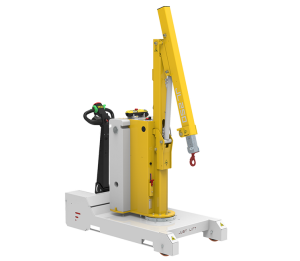
Electric cranes offer an alternative for suitable lifting applications. By using powered lifting mechanisms, they can reduce the physical effort required to raise and position loads. Equipment such as the Just Lift JL250 Hydraulic Mini-Crane provides businesses with a mechanical lifting solution designed to support controlled material handling.
Understanding the differences between traditional Manual Lifting and electric crane operations can help businesses identify safer ways to manage workplace loads. This comparison examines the associated risks, operational differences, equipment considerations and potential benefits of introducing powered lifting technology.
1. Understanding Manual Lifting in the Workplace
Manual Lifting refers to physically raising or lowering an object using human effort. It is commonly performed in warehouses, manufacturing facilities, maintenance workshops, construction environments and distribution centres.
Examples include:
- Raising machinery components onto workbenches.
- Moving heavy tools between storage locations.
- Lifting equipment during installation or maintenance.
- Positioning industrial parts for assembly.
- Transferring awkward materials between workstations.
- Carrying equipment that cannot easily be transported using standard trolleys.
Although these activities may appear straightforward, their safety depends on several factors. The weight of the object is only one consideration. Its dimensions, centre of gravity, grip points, movement path and final positioning requirements can also influence the level of physical effort involved.
A relatively lightweight object can still create a hazardous task if employees must reach overhead, twist their bodies or hold it away from their torso. Similarly, an object with an uneven weight distribution may shift unexpectedly during handling.
Manual Lifting becomes particularly concerning when workers perform the same movements repeatedly throughout a shift. Repeated exertion can gradually increase fatigue, while awkward postures and sudden movements can place additional stress on the body.
Businesses should therefore examine how loads are handled rather than relying solely on employees to use safer lifting techniques. Where practical, redesigning the task or introducing suitable mechanical equipment can reduce exposure to hazardous physical demands.
2. Common Workplace Risks Associated with Manual Lifting
The physical demands of Manual Lifting can contribute to several workplace hazards, particularly when loads are heavy, repetitive or difficult to control. Repeated Manual Lifting can place additional stress on the body’s muscles and joints, increasing the risk of work-related injuries.
Musculoskeletal injuries
Musculoskeletal disorders are injuries or conditions affecting muscles, bones, joints, ligaments, tendons and other supporting tissues.
Common examples include:
- Lower back strains.
- Shoulder injuries.
- Muscle sprains.
- Joint discomfort.
- Tendon injuries.
- Repetitive strain conditions.
These injuries can develop gradually through repeated physical activity or occur suddenly when a worker handles an unstable load. Reducing unnecessary Manual Lifting can help minimise exposure to these physical demands.
Awkward working postures
Employees may need to bend, twist, reach or stretch when handling objects positioned on low shelves, elevated platforms or difficult-to-access work surfaces.
These movements can increase physical stress, particularly when combined with forceful exertion.
Dropped loads
An object may slip from a worker’s hands if it is difficult to grip, poorly balanced or too heavy to control.
Dropped loads can damage equipment, interrupt operations and create serious risks for people working nearby.
Worker fatigue
Repeated physical exertion can contribute to fatigue throughout a shift. As workers become tired, maintaining consistent handling techniques and controlling objects may become more difficult.
Fatigue can also affect concentration and increase the likelihood of mistakes during repetitive handling activities.
Inconsistent handling practices
When employees rely on physical strength to move equipment, the amount of effort required can vary depending on individual capability, experience and fatigue.
This can make it difficult to maintain consistent handling procedures across different workers and shifts.
According to Safe Work Australia, hazardous manual tasks can involve repetitive movement, sustained or sudden force, awkward postures and vibration. These risk factors should be identified and managed as part of workplace health and safety responsibilities.
3. What Are Electric Cranes and How Do They Work?
Electric cranes use powered systems to raise, lower and position loads, reducing the amount of physical effort required from workers.
Depending on their design, these machines may use electric motors, hydraulic lifting systems, mechanical components and specialised lifting attachments.
A battery-powered hydraulic mini-crane combines powered movement with hydraulic lifting capabilities. This arrangement allows an operator to control the movement of the equipment and the positioning of a load without manually raising the object.
Unlike conventional Manual Lifting, where workers provide the physical force needed to raise an object, a powered crane performs the lifting through its mechanical system. This provides an alternative to repetitive Manual Lifting tasks and can help reduce physical demands in suitable workplace applications.
Electric cranes are available in different configurations, including overhead cranes, mobile workshop cranes, jib cranes and compact floor-mounted lifting equipment.
The appropriate type depends on the load characteristics, available working space, lifting height, movement requirements and frequency of use.
Key functions of electric lifting equipment
Depending on the model, electric lifting equipment may provide:
- Powered lifting and lowering.
- Controlled arm extension.
- Load positioning and rotation.
- Battery-powered operation.
- Adjustable lifting configurations.
- Dedicated lifting attachments.
- Operator-controlled movement.
These capabilities can support businesses that regularly move machinery, components and other materials that are difficult to handle physically, reducing the need for certain Manual Lifting activities.
However, powered equipment does not automatically eliminate workplace risks. Operators must still consider load stability, rated capacity, equipment condition, attachment suitability and surrounding hazards.
4. Manual Lifting vs Electric Cranes: Key Safety Differences
Both traditional handling methods and powered lifting equipment have a place in industrial operations. The important consideration is whether the chosen method is appropriate for the task and its associated risks.
The following comparison highlights several differences.
| Safety consideration | Manual Lifting | Electric Cranes |
|---|---|---|
| Physical exertion | Requires human strength | Powered lifting reduces physical effort |
| Repetitive tasks | Can increase physical fatigue | Can reduce repeated lifting demands |
| Load positioning | Depends on worker control | Uses controlled mechanical movement |
| Heavy objects | Limited by safe handling capability | Depends on rated lifting capacity |
| Awkward loads | May be difficult to grip and balance | Suitable attachments can support handling |
| Operator involvement | Direct physical handling | Requires trained equipment operation |
| Workplace hazards | Strains, dropped loads and awkward postures | Stability, suspended loads and equipment hazards |
| Consistency | Can vary between workers | Can provide more consistent mechanical movement |
Reducing physical exertion
One of the main advantages of an electric crane is its ability to perform the lifting operation mechanically.
With Manual Lifting, employees must generate the force needed to raise an object. This can become demanding when handling equipment repeatedly or positioning loads at different heights.
A powered crane transfers much of that lifting effort to the machine. Workers can concentrate on operating the controls, monitoring the load and maintaining a safe working area.
Improving load control
Handling a heavy or awkward object manually can make it difficult to maintain a stable position throughout the lifting process.
An electric crane can provide more controlled lifting and positioning when operated correctly. Its lifting mechanism and suitable attachments can help support a load during movement.
However, operators must still account for load swing, balance, attachment security and potential obstructions.
Managing repetitive tasks
In workplaces where employees repeatedly raise and position machinery components, physical exertion can accumulate throughout the day.
Replacing suitable repetitive lifting activities with mechanical equipment can reduce the frequency of physically demanding movements.
This can help businesses improve their overall approach to ergonomic risk management.
Supporting consistent operations
Mechanical lifting equipment can provide a more repeatable handling method than relying on individual physical capability.
However, consistency depends on proper operating procedures, equipment maintenance, operator training and appropriate task planning.
5. How Electric Cranes Can Help Reduce Workplace Injury Risks
Introducing suitable lifting equipment can be an important part of a workplace injury prevention strategy, particularly in environments where Manual Lifting is a regular requirement.
The objective is not simply to move heavier objects. It is to redesign handling activities so that employees are exposed to fewer hazardous physical demands.
Reducing strain on the back and shoulders
Lifting heavy objects can place significant demands on the back, shoulders and upper body.
A powered crane can reduce the need for workers to physically raise loads, particularly when transferring machinery components between floor level and work surfaces.
This may help reduce exposure to some physical risk factors associated with hazardous tasks and repetitive Manual Lifting.
Limiting awkward handling movements
Some objects are difficult to grip because of their dimensions, shape or weight distribution.
Attempting Manual Lifting of these objects may require employees to adopt uncomfortable positions or reach around equipment.
A suitable crane attachment can support the load while the operator controls its movement. This may reduce the need for employees to hold objects in awkward positions during positioning.
Improving control during installation and maintenance
Maintenance activities often involve moving components into specific locations where accurate positioning is important.
A powered lifting system can help operators raise and position these components while monitoring their movement.
This is particularly useful when handling machinery parts that are difficult to reposition once installed, reducing the physical demands associated with Manual Lifting.
Reducing dependence on physical strength
A safer workplace should not depend on employees being physically capable of repeatedly handling demanding loads.
Introducing mechanical assistance can help reduce reliance on individual strength and improve the way handling tasks are organised.
It is still necessary to consider the physical demands of other activities, including pushing, pulling, guiding and securing equipment.
By reducing unnecessary Manual Lifting, businesses can improve material handling practices while supporting a more consistent approach to workplace safety.
6. Introducing the Just Lift JL250 Hydraulic Mini-Crane
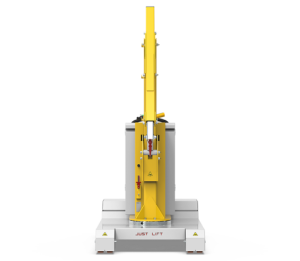
For businesses seeking a compact powered lifting solution, the Just Lift JL250 Hydraulic Mini-Crane is a suitable option to consider.
Designed for light-load lifting and material handling applications, the JL250 combines battery-powered mobility with hydraulic lifting and arm extension.
Its counterbalanced floor-mounted design supports lifting operations in environments where a larger fixed crane installation may not be practical.
<em>Product: Just Lift JL250 Hydraulic Mini-Crane</em>
Key product features
- Maximum lifting capacity: Up to 250 kg.
- Power supply: Battery.
- Driving system: Electric tiller.
- Lifting mechanism: Hydraulic lifting and arm extension.
- Arm control: Wired control.
- Rotation: Up to 270°.
- Safety feature: Standard anti-tipping system.
- Additional option: Compatible with suitable lifting chains and arm extensions.
The JL250 is designed to simplify lifting and handling operations involving loads within its rated capacity.
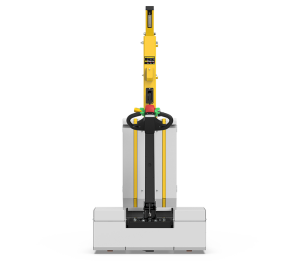
Its compact dimensions also make it suitable for consideration in workplaces with narrower aisles and restricted operating spaces.
270-degree rotation for load positioning
One of the JL250’s notable features is its 270-degree rotation system.
The turntable ball bearing supports smooth rotational movement, with locking positions at 45-degree intervals.
This allows operators to position the crane arm in different directions depending on the task and available working space.
For maintenance workshops and production environments, this feature can assist with positioning components around machinery and workstations.
Hydraulic lifting and arm extension
The JL250 uses a hydraulic system to raise loads and extend its lifting arm.
The arm movements are operated using wired controls, allowing the operator to manage the lifting process without physically raising the load.
Its lifting capacity changes according to the arm extension position:
- First arm position: Up to 250 kg.
- Second arm position: Up to 160 kg.
- Third arm position: Up to 130 kg.
The third position uses an additional extension that must be added manually.
These capacities apply under the manufacturer’s stated conditions, including level ground and the arm parallel to the floor. Operators must follow the product documentation and applicable load limits for every configuration.
Compact dimensions for workplace use
The JL250 has the following published dimensions:
| Specification | Measurement |
|---|---|
| Length | 1,840 mm |
| Width | 780 mm |
| Total height | 2,310 mm |
| Steering diameter | 1,050 mm |
| Weight without batteries | 610 kg |
| Weight with batteries | 680 kg |
Its relatively compact footprint can help businesses assess whether powered lifting is practical within their existing work areas.
The machine’s own weight and steering clearance must still be considered when planning access routes, floor loading and operating space.
7. Where Can the JL250 Be Used?
The JL250 can be considered for different light-load industrial lifting applications where its capacity, dimensions and configuration are appropriate. It can also help reduce the need for repetitive Manual Lifting in suitable workplace environments.
Manufacturing facilities
Manufacturing environments regularly handle components during assembly, production and equipment maintenance.
A powered mini-crane can help position suitable components at workstations, reducing the need for employees to raise objects physically through Manual Lifting.
Maintenance workshops
Maintenance technicians may need to remove, replace or reposition machinery components during servicing.
Where the load and working conditions are suitable, a mobile hydraulic crane can assist with lifting components into position, minimising demanding Manual Lifting activities.
Warehouses and distribution facilities
Some warehouse operations involve handling equipment or materials that cannot be moved conveniently using standard trolleys.
A suitable lifting crane can support selected loading, unloading and positioning activities, reducing reliance on Manual Lifting where mechanical assistance is appropriate.
Industrial installation work
Installing machinery and equipment may require components to be raised and aligned within restricted spaces.
The JL250’s rotating arm and hydraulic extension can help operators manage certain positioning requirements without relying entirely on Manual Lifting.
Equipment servicing
Workshops servicing commercial and industrial equipment may benefit from a mechanical lifting solution when components need to be removed or repositioned.
In these applications, businesses should assess the load weight, lifting points, attachment requirements and available operating clearance before using the equipment. Selecting suitable lifting equipment can help reduce unnecessary Manual Lifting and support safer servicing procedures.
8. When Is Manual Lifting Still Appropriate?
Although powered lifting equipment offers advantages for many industrial applications, not every object requires an electric crane.
Manual Lifting may remain appropriate when objects are lightweight, stable, easy to grip and can be moved without exposing workers to hazardous physical demands.
Examples may include:
- Small tools and accessories.
- Lightweight components.
- Low-weight packages.
- Materials that can be handled comfortably within an appropriate working area.
- Occasional tasks that do not involve excessive force or awkward postures.
The decision should always be based on a task-specific risk assessment rather than a universal weight limit.
Australian workplace safety guidance does not establish one simple maximum weight that makes every lifting task safe. Factors such as repetition, posture, force, duration and the characteristics of the load must also be considered.
Where a task presents a risk, businesses should consider whether it can be eliminated or redesigned using mechanical assistance.
9. Important Safety Considerations When Using Electric Cranes
Powered lifting equipment can reduce certain physical demands, but it introduces other operational hazards that must be managed.
Businesses should establish appropriate procedures before introducing an electric crane into the workplace.
Check the rated lifting capacity
Never assume that the crane can lift its maximum rated load in every configuration.
The JL250’s capacity decreases as its arm extends. Operators must check the relevant load rating before every lifting operation.
Inspect lifting attachments
Chains, hooks and other attachments must be appropriate for the load and compatible with the lifting equipment.
Inspect attachments for visible damage, wear and defects before use.
Maintain a stable operating surface
The JL250’s published lifting capacities are specified for level ground under stated operating conditions.
Uneven surfaces, slopes and unsuitable floor conditions can affect stability and should be assessed before operating the equipment.
Keep people clear of suspended loads
Workers should never position themselves beneath suspended loads.
Establish exclusion zones where appropriate and maintain communication between operators and other employees.
Provide operator training
Employees must understand the crane’s controls, rated capacities, operating limitations and emergency procedures.
Training should also cover pre-start inspections and the correct use of lifting attachments.
Maintain equipment regularly
Batteries, hydraulic components, mechanical systems, controls and safety features should be inspected and maintained according to manufacturer recommendations.
Damaged or defective equipment should be removed from service until it has been assessed and repaired.
10. How Businesses Can Decide Between Manual Lifting and Electric Cranes
Selecting the right handling method requires an understanding of the task, the workplace and the potential risks.
Rather than choosing equipment based only on maximum load capacity, businesses should examine how frequently objects are moved and the physical demands involved.
Consider the following factors:
1. Load weight and dimensions
Determine the weight, size, shape and centre of gravity of the objects being handled. Consider whether the load has suitable lifting points.
2. Frequency of handling
Occasional lightweight tasks may not require powered equipment. Repetitive lifting activities may benefit from mechanical assistance.
3. Required lifting height
Consider whether objects need to be raised from floor level, positioned on workbenches or transferred into machinery.
4. Available workspace
Measure aisle widths, doorways, turning areas and operating clearances. Ensure the equipment can move and operate safely within the intended environment.
5. Operator requirements
Identify who will operate the equipment and what training, procedures and supervision are necessary.
6. Overall workplace risk
Assess the complete handling process, including lifting, lowering, positioning, attachment, guiding and final placement.
Businesses should consult employees who regularly perform these tasks because they can often identify practical handling difficulties that may not be obvious during an initial inspection.
11. The Role of Mechanical Aids in Workplace Safety
Mechanical lifting equipment is one part of a broader workplace safety strategy.
The goal should be to eliminate hazardous handling tasks wherever reasonably practicable. Where elimination is not possible, businesses should implement appropriate controls to minimise the remaining risks.
Mechanical aids can provide an engineering control by changing how physical work is performed.
For example, instead of requiring employees to physically raise a heavy machinery component, a suitable crane can perform the lifting operation.
However, using a crane does not automatically make every part of the task safe. Employees may still need to guide the load, connect attachments, operate controls or move around the equipment.
A complete safety approach should therefore include:
- Identifying hazardous handling activities.
- Assessing the risks associated with each task.
- Selecting suitable mechanical equipment.
- Establishing safe operating procedures.
- Training employees in equipment use.
- Inspecting and maintaining lifting equipment.
- Reviewing controls when tasks or workplace conditions change.
This approach helps businesses address the causes of workplace hazards rather than relying exclusively on individual handling techniques.
12. Improving Workplace Handling Practices for the Long Term
Reducing dependence on Manual Lifting requires more than purchasing a new piece of equipment. Businesses should review their overall material handling processes to identify where improvements can be made.
For example, frequently handled components could be stored at more accessible heights. Workstations could be redesigned to reduce reaching and twisting. Materials could be delivered closer to their point of use, reducing unnecessary movement and repetitive Manual Lifting tasks.
Where heavy or awkward objects still need to be raised, powered lifting equipment may provide a more suitable method.
Businesses should also monitor how employees use the equipment after implementation. If workers continue to perform hazardous Manual Lifting activities because the crane is difficult to access or unsuitable for the task, the original safety objective may not be achieved.
Equipment selection should therefore consider accessibility, operating requirements, maintenance and employee feedback.
The most effective solution is one that fits naturally into the workplace’s daily operations while addressing the identified risks.
Conclusion: Choosing a Safer Approach to Workplace Lifting
The comparison between Manual Lifting and electric cranes demonstrates why businesses should carefully evaluate how materials and equipment are handled.
Physical lifting may be appropriate for lightweight objects and tasks that do not create hazardous demands. However, repetitive, forceful or awkward Manual Lifting activities can expose workers to unnecessary physical risks.
Electric cranes provide a mechanical alternative for suitable lifting applications. By transferring the lifting force to powered equipment, they can reduce the physical effort required from employees and support more controlled load positioning.
The Just Lift JL250 Hydraulic Mini-Crane offers a practical option for businesses handling loads up to 250 kg. Its battery-powered driving system, hydraulic lifting and extension, 270-degree rotation and standard anti-tipping system make it worth considering for suitable industrial and workshop applications.
Ultimately, choosing between Manual Lifting and powered lifting should be based on a thorough assessment of the task, the load and the workplace environment.
For businesses looking to improve handling practices, investing in appropriate mechanical lifting equipment can be an important step towards reducing hazardous physical demands and supporting a safer working environment.
To discover how the Just Lift JL250 Hydraulic Mini-Crane can support your material handling requirements, contact Emoveit on 1300 213 010 or email sales@emoveit.com.au.