



How Tracked Electric Dumpers Help Move Loads Across Uneven Ground
Moving materials across uneven ground can create challenges for construction teams, industrial maintenance crews, restoration specialists and other businesses that handle heavy or awkward loads. Loose soil, gravel, rough concrete, confined work areas and changing ground conditions can make conventional material-handling methods difficult to manage.
For businesses working in these environments, selecting suitable transport equipment is an important part of improving productivity and managing workplace risks. Tracked Electric Dumpers offer an alternative to conventional wheelbarrows and some wheeled carriers by combining electric power with a tracked drive system designed to support movement across challenging surfaces.
Unlike traditional petrol-powered equipment, electric tracked carriers operate without producing hazardous exhaust during use. This can make them worth considering for selected indoor restoration projects, underground work and other applications where combustion-engine exhaust is undesirable. Their suitability will depend on the specific working environment, load requirements and equipment configuration.
Tracked Electric Dumpers can also help businesses review how materials are transported between work areas. Rather than relying entirely on manual carrying, workers can use powered equipment to move compatible loads while reducing some of the physical effort associated with material transport.
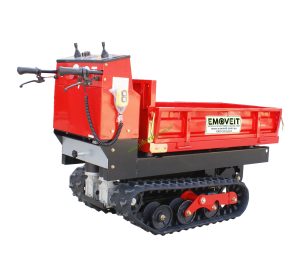
The Hi Lift Mini Dumper on Track T373 from Emoveit is one example of a tracked electric material carrier. With a stated load capacity of 250 kg and two 24 V, 600 W DC motors, it is designed for industrial maintenance, repair, restoration and material movement in demanding environments.
Understanding how tracked equipment works, where it may be useful and which operating limitations matter can help businesses determine whether this type of machine is appropriate for their operations.
What Are Tracked Electric Dumpers?
Tracked Electric Dumpers are powered material-handling machines that use continuous tracks rather than conventional tyres as their primary ground-contact system. The tracks distribute the machine’s weight across a contact area, helping it maintain traction on certain surfaces where wheeled equipment may struggle.
The exact benefits depend on track design, machine weight, load distribution, ground conditions and operating technique. Tracks do not automatically make a machine suitable for every slope, muddy surface or unstable worksite. Nevertheless, this configuration can provide practical advantages when transporting materials across rough or variable terrain.
Electric power is another important characteristic. Battery-powered motors drive the equipment without producing exhaust from fuel combustion at the point of operation. This can be useful in locations where exhaust fumes are undesirable, including some enclosed or underground work areas. Adequate ventilation and compliance with site-specific requirements remain essential.
Tracked Electric Dumpers are available in different configurations, capacities and control systems. Some feature tipping bodies for unloading loose materials, while others use platforms or specialised carrying arrangements for particular tasks.
Before choosing a machine, businesses should distinguish between a tracked dumper, a tracked carrier and a tracked lifting or tipping platform. These products may share a tracked drive system, but their functions and operating limitations can differ considerably.
The Hi Lift Mini Dumper on Track T373 is a tracked electric carrier designed for material transport and demanding industrial applications. Businesses should review its exact configuration and specifications to determine whether it suits the intended task.
Why Is Moving Loads Across Uneven Ground Difficult?
Uneven terrain affects the stability, movement and control of material-handling equipment. A route that appears manageable when empty may become more difficult when a machine is carrying a heavy load.
Common challenges include:
Loose surfaces: Gravel, sand, loose soil and disturbed ground can reduce traction or shift beneath the machine. Equipment must be suitable for the surface and the conditions encountered.
Changes in ground level: Small ridges, depressions and transitions between surfaces can affect movement and load stability.
Slopes: Inclines and declines change the forces acting on a machine and its load. A slope that is manageable for one configuration may be unsuitable for another.
Wet or slippery areas: Water, mud and other contaminants can change traction and increase the risk of slipping or losing control.
Restricted access: Construction sites, tunnels and maintenance areas may contain narrow routes, obstacles and limited turning space.
Repeated manual handling: Carrying materials over long or irregular routes can increase physical demands and make work slower.
These challenges can affect both workers and equipment. Australia’s workplace safety guidance identifies uneven ground, restricted movement and hazardous manual tasks as factors that should be considered when planning material-handling activities.
Tracked Electric Dumpers may help address some transport challenges, but they are not a substitute for evaluating the route, assessing the load and establishing appropriate operating procedures.
How Tracked Electric Dumpers Help Maintain Traction
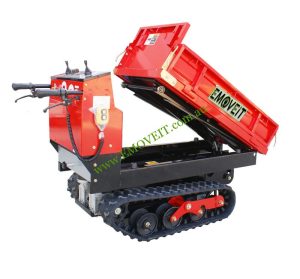
One of the main reasons businesses consider tracked equipment is its potential to maintain traction across suitable uneven surfaces.
1. A Larger Ground-Contact Area
Tracks generally provide a longer ground-contact area than individual wheels. Depending on the machine’s design, this can distribute weight across a broader section of the surface.
Weight distribution matters when equipment travels over loose or relatively soft ground. Concentrated loads can cause wheels to sink into certain surfaces, increasing rolling resistance and making movement more difficult.
Tracked Electric Dumpers can offer an alternative in applications where a tracked undercarriage is appropriate. However, actual ground pressure depends on the machine’s weight, track dimensions and load. Buyers should not assume that every tracked machine produces low ground pressure or can travel across sensitive surfaces without damage.
2. Continuous Contact With the Surface
A tracked undercarriage maintains a continuous track along the ground rather than relying on separate tyre contact points. This arrangement can support movement across some irregular surfaces.
The result depends on the terrain and track configuration. Deep holes, large obstacles, unstable edges and unsuitable slopes can still create significant hazards.
When evaluating Tracked Electric Dumpers, businesses should identify the most difficult sections of the intended route rather than assessing equipment suitability only on relatively flat ground.
3. Powered Movement
An electric drive system supplies the power needed to move the machine and its load. This can reduce reliance on manually pushing or pulling a loaded carrier.
The extent of the benefit depends on the task, operating conditions, travel distance and load weight. Workers must still guide or control the equipment according to its operating instructions and maintain awareness of surrounding hazards.
For regular transport tasks, powered tracked equipment may help establish a more consistent process for moving materials between work areas.
Why Choose Electric Power for Material Handling?
Electric power can offer several practical advantages over combustion-powered alternatives, although the best choice depends on the application.
No Exhaust From Fuel Combustion During Operation
Battery-electric equipment does not produce exhaust from an onboard combustion engine during normal operation. This is a relevant consideration for indoor restoration, underground maintenance and other tasks where engine exhaust may be unacceptable.
The Hi Lift Mini Dumper on Track T373 is described by Emoveit as suitable for indoor restoration work and environments where the exhaust, noise and smell of a combustion engine are undesirable.
This does not mean that every enclosed work area is automatically suitable for electric equipment. Businesses should consider ventilation, battery safety, charging arrangements and other site requirements.
Noise Considerations
Noise can affect communication, concentration and working conditions, particularly in enclosed or occupied facilities.
Electric tracked machines can avoid the engine noise associated with petrol- or diesel-powered equipment. However, the electric drive, tracks, load and contact with the ground can still generate sound.
Businesses considering Tracked Electric Dumpers should evaluate noise under actual operating conditions. Where noise limits apply, measurements and site-specific assessments may be necessary.
Energy Use
Electric motors can convert electrical energy into movement without the exhaust and fuel-combustion processes associated with conventional engines.
The practical efficiency of a machine depends on its motor, battery, load, speed, route, terrain and operating cycle. Rough surfaces and heavy loads can increase energy consumption, so businesses should assess battery capacity and charging requirements against their expected workload.
Maintenance Planning
Electric equipment does not require routine engine oil changes or exhaust-system servicing associated with combustion engines. Nevertheless, it still requires appropriate maintenance.
Tracks, motors, electrical connections, batteries, controls and safety devices should be inspected and maintained according to the manufacturer’s instructions.
For operations that depend on reliable material transport, a planned maintenance schedule can help identify wear and faults before they cause avoidable downtime.
Introducing the Hi Lift Mini Dumper on Track T373
The Hi Lift Mini Dumper on Track T373 is an example of equipment designed to move materials in environments where tracked mobility and electric operation may be advantageous.
Emoveit lists the following specifications for the T373:
- Load capacity: 250 kg
- Motor: 24 V / 600 W DC × 2
- Drive system: Tracks
- Cargo dimensions: 1,150 mm long × 740 mm wide × 200 mm high
These specifications provide a starting point for evaluating the machine’s suitability. Businesses should confirm the exact model, available configuration and current technical documentation before purchasing.
The T373 is intended for demanding applications, including building sites, tunnels, industrial maintenance, repair and restoration work. Its tracked configuration and electric drive make it a relevant option to investigate when conventional wheeled equipment is not the preferred solution.
Importantly, the T373 should not be treated as suitable for every type of terrain simply because it uses tracks. The machine’s limitations, load capacity, route conditions and operating instructions must be considered before use.
For businesses comparing Tracked Electric Dumpers, the T373 provides a practical example of how an electric tracked carrier can be specified for particular material-handling requirements.
Understanding the T373’s 250 kg Load Capacity
Load capacity is one of the first specifications to consider when selecting material-handling equipment.
The T373 has a stated capacity of 250 kg. This gives businesses a defined starting point when evaluating the materials they intend to transport.
However, the rated capacity should never be treated as a target that can be exceeded whenever the ground appears stable.
Before loading the machine, consider:
- The total weight of the materials.
- How evenly the load is distributed.
- Whether the load can shift during movement.
- The dimensions and shape of the items.
- The visibility available to the operator.
- The condition and gradient of the route.
- Any restrictions specified by the manufacturer.
A load can create handling difficulties even when its weight is within the stated limit. Bulky or poorly balanced items may affect visibility and stability, while loose materials may shift as the machine moves.
Tracked Electric Dumpers should be selected according to both the weight and the nature of the load. The equipment must also be appropriate for the conditions in which it will operate.
For loads approaching the rated capacity, businesses should follow the manufacturer’s instructions carefully and avoid assumptions about performance on slopes or unstable ground.
Applications for Tracked Electric Dumpers
The usefulness of tracked equipment extends across several industries, provided the machine is suited to the task.
Construction and Building Projects
Construction sites often involve moving materials between storage points, work areas and temporary access routes.
Depending on the machine configuration, tracked electric carriers may be considered for transporting compatible tools, components and other materials across suitable uneven surfaces.
Their potential applications should be assessed against the site layout, access restrictions, material dimensions and ground conditions.
Construction teams should also account for pedestrians, other machinery, excavation edges and temporary structures when establishing transport routes.
Industrial Maintenance
Maintenance teams may need to transport tools, replacement components and supplies to equipment located in areas that are difficult to access.
Tracked Electric Dumpers can be considered when a tracked platform is suitable for the route and the load. This may be relevant to certain industrial facilities, infrastructure projects and specialised maintenance environments.
The equipment’s dimensions are important when working in confined spaces. Operators need sufficient clearance to manoeuvre safely and maintain visibility of the path ahead.
Restoration and Renovation
Restoration projects can involve moving materials through buildings where conventional combustion-powered machinery is undesirable.
Electric tracked carriers may be worth considering for suitable tasks involving indoor restoration or maintenance. Their lack of combustion exhaust during operation can be advantageous in environments where engine fumes present a concern.
However, indoor use requires careful planning. Floor load limits, surface protection, access dimensions, ventilation and emergency arrangements should be evaluated before introducing mobile equipment.
Tunnels and Underground Work
Underground environments can present access challenges and restrictions on equipment emissions.
The T373 is identified by Emoveit as suitable for applications such as tunnels and underground work where tracked traction and zero exhaust emissions are important.
Businesses must still check tunnel-specific requirements, including ventilation, clearance, emergency access, lighting and equipment suitability.
Tracked Electric Dumpers should only be used where the machine’s operating limits and the site’s risk controls allow safe operation.
Agricultural and Outdoor Maintenance Tasks
Some agricultural, vineyard and outdoor maintenance activities involve transporting tools and supplies across ground that is not consistently paved.
Tracked equipment may be appropriate for selected routes where its design, dimensions and load capacity match the task.
Ground conditions can change rapidly after rainfall or during site preparation. Operators should reassess the route whenever conditions change and avoid surfaces that exceed the machine’s operating limitations.
How Tracked Electric Dumpers Can Support Workplace Safety
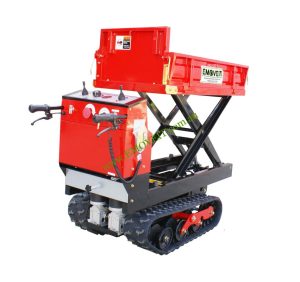
Powered material-handling equipment can help businesses reduce some of the physical demands associated with manually moving loads. However, introducing machinery also creates hazards that must be managed.
Reducing Repetitive Physical Effort
Repeatedly carrying or pushing heavy materials can contribute to physical strain, especially over long distances or irregular routes.
Using appropriate powered equipment can reduce the manual effort required to transport compatible loads. This may be beneficial for tasks that involve repeated material movements throughout a shift.
The machine does not eliminate all manual handling. Workers may still need to load, secure, position or unload materials, and these activities require their own risk controls.
Maintaining Load Stability
An unstable load can shift during movement, affect machine control or fall onto nearby workers.
Loads should be arranged securely, with their weight distributed appropriately and their movement restricted where necessary. Operators should avoid sudden changes in direction and follow the manufacturer’s guidance for loading and unloading.
Businesses should also determine whether the load’s size or position obstructs the operator’s view.
Managing Pedestrian Interaction
Construction, maintenance and industrial workplaces often contain workers moving through the same areas as mobile equipment.
A safe operating plan should identify pedestrian routes, blind spots, crossing points and restricted areas. Depending on the environment, barriers, warning systems, designated routes or a spotter may be necessary.
Tracked Electric Dumpers must be operated with awareness of people and obstacles around the machine. Electric power does not remove the risks associated with moving plant.
Assessing Ground Conditions
Before operating on uneven terrain, assess the route for loose material, holes, soft ground, slopes, water, unstable edges and other hazards.
The suitability of a tracked machine depends on its specific design and operating limits. Tracks alone do not guarantee safe operation on steep, slippery or unstable ground.
Operators should stop and reassess conditions when the route becomes unsuitable. Where necessary, the work area should be prepared or an alternative transport method selected.
Safe Work Australia’s guidance on managing plant risks provides a useful framework for identifying hazards, selecting controls and ensuring equipment is suitable for its intended use.
Improving Material-Handling Efficiency
Efficiency is not simply a matter of moving materials faster. It also involves reducing unnecessary handling, organising routes and choosing equipment that matches the workload.
Establishing More Consistent Transport Processes
Businesses can review how often materials need to be moved, where they originate and where they are required.
A suitable powered carrier may help standardise recurring transport tasks by providing a consistent method for moving compatible loads between designated locations.
The value of this approach depends on the frequency of use, travel distance, load requirements and available charging time.
Reducing Unnecessary Trips
Planning the load before each movement can help avoid repeated journeys.
Workers should determine which items can be transported together without exceeding the machine’s rated capacity or compromising load stability. Loads should remain secure and manageable throughout the journey.
Tracked Electric Dumpers can support a planned transport process when the machine’s carrying arrangement and dimensions suit the materials involved.
Considering Access and Manoeuvrability
Equipment that cannot travel safely through the available route will not improve productivity.
Measure narrow access points, doorways, turning areas and transitions between surfaces. Compare these dimensions with the machine’s overall size and turning requirements.
Businesses should also consider where materials will be loaded and unloaded. A suitable transport route needs enough space for the complete task, not just the journey itself.
Planning Battery Charging
Battery-powered equipment requires a charging strategy that reflects the workload.
Businesses should review the manufacturer’s battery specifications, charging times, expected operating cycle and recommended charging conditions.
A charging plan can help reduce avoidable downtime and ensure that equipment is available when needed. Battery maintenance and inspection should also form part of the operating schedule.
What to Consider Before Choosing Tracked Electric Dumpers
Not every material-handling task requires a tracked machine. Selecting the right equipment begins with understanding the work.
Load capacity: Establish the maximum expected load, including any containers, attachments or materials carried.
Ground conditions: Identify the surfaces the machine must cross and determine whether its track system is appropriate.
Gradient limitations: Check the manufacturer’s approved operating conditions. Do not assume that a tracked machine can safely climb or descend any slope.
Machine dimensions: Measure access routes, turning areas and working clearances.
Operating controls: Understand how the machine is controlled and which safety features are included in the selected configuration.
Battery requirements: Confirm operating duration, charging arrangements and battery maintenance needs.
Load configuration: Determine whether the carrying platform or body suits the dimensions, shape and stability requirements of the materials.
Maintenance support: Review inspection requirements, replacement parts availability and servicing arrangements.
Operator training: Ensure operators understand the machine’s controls, limitations and emergency procedures.
Site-specific risks: Assess interactions with pedestrians, other plant, overhead obstructions and changes in ground conditions.
A structured assessment helps businesses compare Tracked Electric Dumpers with wheeled carriers, conventional wheelbarrows and other transport options.
Tracked Electric Dumpers Versus Wheeled Carriers
Tracked and wheeled equipment serve overlapping but different purposes. The appropriate choice depends on the operating environment.
Wheeled carriers may be suitable for firm, level surfaces where rolling resistance is low and the route is predictable. They may also be easier to manoeuvre in applications designed around conventional tyres.
Tracked equipment may offer advantages on selected rough or loose surfaces because of its continuous ground-contact system. However, it may not be the best choice for polished floors, delicate surfaces or environments where track contact could cause damage.
Electric tracked equipment also requires attention to battery charging, track inspection and electrical-system maintenance.
When comparing Tracked Electric Dumpers with wheeled alternatives, businesses should consider the complete operating task rather than focusing on a single feature. The right machine is one that meets the load requirements, suits the route and can be operated safely and efficiently.
Common Mistakes to Avoid When Moving Loads on Uneven Ground
Even suitable equipment can become unsafe when it is operated outside its intended limits.
Overloading the machine: Never exceed the manufacturer’s rated capacity. Consider load distribution and stability as well as total weight.
Assuming tracks eliminate ground hazards: Tracks can improve traction in some conditions, but they do not remove the risks posed by unstable ground, steep slopes or soft surfaces.
Ignoring changes in weather: Rain can alter ground firmness and traction. Reassess routes when conditions change.
Carrying unsecured materials: Loads that move during travel can affect stability and create hazards for nearby workers.
Failing to inspect the equipment: Damaged tracks, worn components, electrical faults or defective controls should be addressed before operation.
Neglecting pedestrian safety: Establish appropriate separation and communication procedures where people and mobile equipment share an area.
Using equipment for an unsuitable task: Confirm that the machine’s carrying arrangement, capacity and operating limits match the intended application.
Avoiding these mistakes requires clear procedures, competent operators, suitable equipment and ongoing attention to working conditions.
Is the Hi Lift Mini Dumper on Track T373 Right for Your Operation?
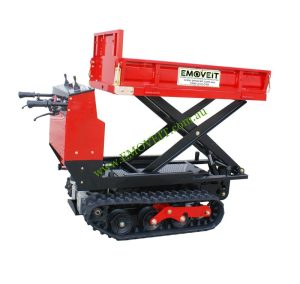
The Hi Lift Mini Dumper on Track T373 is worth considering for businesses that need a compact tracked electric carrier for compatible loads in demanding work environments.
Its stated 250 kg capacity and twin 24 V, 600 W DC motors provide useful starting points for assessing the equipment against specific material-handling requirements.
The T373 may be relevant to construction, industrial maintenance, repair, restoration and selected underground applications where its tracked configuration and electric drive offer practical advantages.
Before selecting the machine, businesses should confirm the exact model configuration, dimensions, battery specifications, control arrangements and approved operating conditions. The intended route and load should then be assessed against the manufacturer’s instructions.
The most suitable equipment will depend on the complete task, including how materials are loaded, transported, positioned and unloaded.
For businesses evaluating Tracked Electric Dumpers, comparing the T373’s specifications with the requirements of the work can help establish whether it is an appropriate solution.
Conclusion: Selecting the Right Equipment for Uneven Ground
Moving materials across uneven ground requires more than choosing a machine with sufficient load capacity. Businesses must consider traction, load stability, ground conditions, access restrictions, operating controls and the physical demands placed on workers.
Tracked Electric Dumpers provide one option for selected applications where a tracked drive system and electric power suit the working environment. They may help businesses organise material transport, reduce some manual handling demands and avoid combustion exhaust during operation.
However, tracks do not guarantee suitability for every surface, and electric equipment still requires appropriate maintenance, charging and risk management.
The Hi Lift Mini Dumper on Track T373 is an example of a tracked electric carrier designed for demanding material-handling environments. Its 250 kg capacity makes it important to assess load requirements carefully, while its tracked configuration makes route suitability a central part of the selection process.
Ultimately, the best equipment choice is determined by the task, the environment and the operating limits of the machine. By evaluating these factors before purchase, businesses can make better-informed decisions about material-handling equipment for uneven ground.
To discuss tracked electric material-handling solutions for your application, contact Emoveit to review your requirements and identify an appropriate equipment option.