


Simpro Bin Tippers vs Custom Fabrications: Which Is Safer?
When a workplace needs to lift and tip heavy waste bins, choosing the right equipment involves more than comparing lifting capacity and tipping height. Safety, guarding, machine design, operator interaction and risk management all need to be considered.
This is where the choice between Simpro Bin Tippers and a custom-fabricated bin tipping system becomes important.
A custom fabrication can be designed around a specific application, container or production process. However, the safety of that equipment depends heavily on how thoroughly the machine has been engineered, risk assessed, guarded, commissioned and maintained.
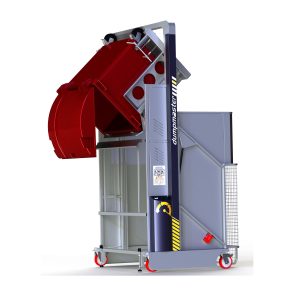
Simpro Bin Tippers, such as the MegaDumper Extra HD, are purpose-designed industrial bin lifting systems with integrated guarding, safety interlocks and safety-related control features. The MegaDumper Extra HD is designed for applications involving larger commercial bins, with a capacity of up to 750 kg and tipping heights of up to 1,800 mm in the configuration offered by Emoveit.
So, when comparing Simpro Bin Tippers with custom fabrications, the more useful question is not simply “Which one is safer?”
The better question is:
Which solution provides the appropriate level of engineered safety for the intended application?
What Are Simpro Bin Tippers?
Simpro Bin Tippers are purpose-built machines designed to lift and empty bins or containers while controlling the movement of the load.
The Simpro range includes several bin lifting and tipping solutions, with the MegaDumper designed for larger and heavier commercial containers.
The MegaDumper Extra HD available through Emoveit has a rated capacity of up to 750 kg, supports 660 L and 1100 L bins, and can provide a tipping height of up to 1,800 mm. Its highest tip point can reach up to approximately 3,645 mm, depending on configuration.
The machine is designed around a controlled lifting and tipping movement rather than simply rotating the bin around a basic pivot point.
This is important because the movement of a heavy container can affect stability, load distribution and the forces acting on the equipment throughout the tipping cycle.
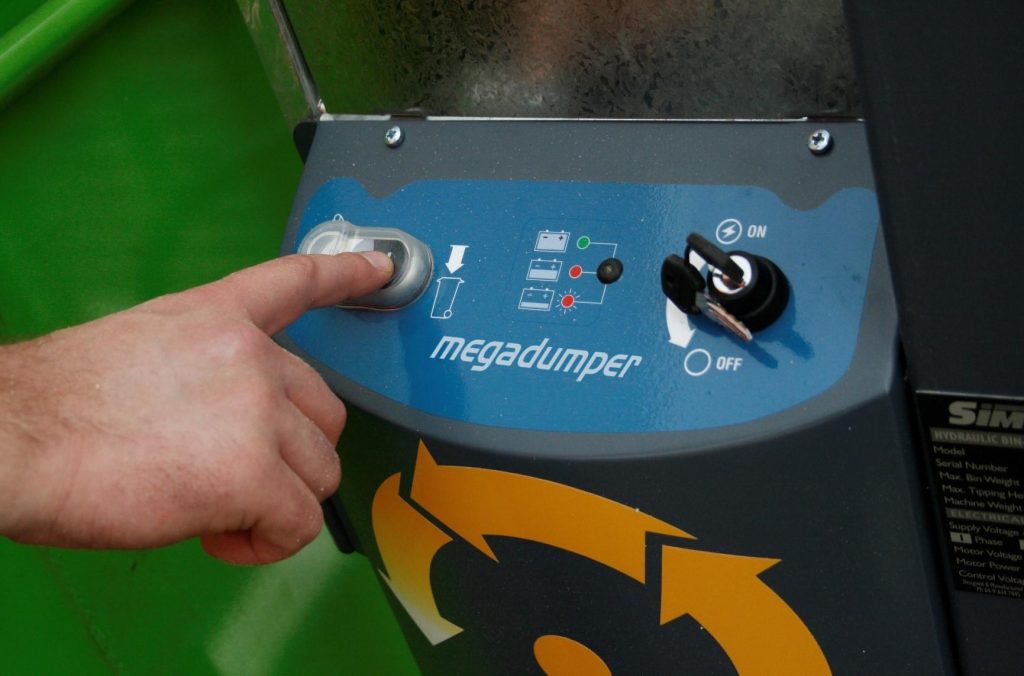
Simpro’s MegaDumper documentation identifies several safety features, including guarding around moving parts, a safety interlock system, controlled lowering and operator controls designed to prevent unintended operation.
Why Safety Engineering Matters in Bin Tipping
Bin tipping involves several potential hazards.
Depending on the application, these may include:
- Crushing points
- Pinch points
- Entanglement hazards
- Unexpected movement
- Falling or unsecured loads
- Access to moving components
- Hydraulic system hazards
- Electrical hazards
- Material falling from the container
- Unauthorised or incorrect operation
The risk increases when the machine handles heavy containers at elevated heights.
For example, a 750 kg load being lifted several metres above floor level requires considerably more attention to structural integrity, stability, guarding and control systems than a simple manually handled waste container.
Safe Work Australia identifies safe machinery design and risk assessment as important parts of managing plant-related hazards, and references AS/NZS 4024.1201:2014 for general principles of machinery design, risk assessment and risk reduction.
This means safety should be considered from the design stage rather than added after the machine has already been built.
How Simpro Bin Tippers Approach Guarding
One of the major areas to examine when comparing Simpro Bin Tippers vs custom fabrications is guarding.
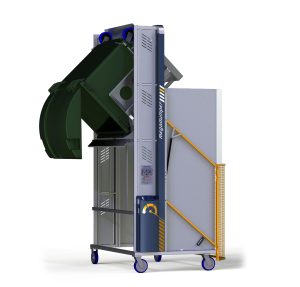
The MegaDumper incorporates guarding intended to restrict access to moving parts. Its documentation identifies mesh and sheet-metal panels that prevent access to moving components.
This matters because the lifting and tipping mechanism contains areas where operators could potentially be exposed to moving components.
A guard is not simply a physical barrier. It forms part of the overall safety system.
The MegaDumper also incorporates a safety door interlock. According to Simpro’s user manual, the machine is disabled unless the door is shut, while the door is electrically locked when the cradle is raised from the ground.
This type of engineered interaction between the machine’s position and its safety system is an important consideration when assessing industrial equipment.
What Happens With a Custom Fabrication?
A custom fabrication is not inherently unsafe.
In fact, there are situations where a custom-built machine may be appropriate because the application has unusual dimensions, container types, loading arrangements or integration requirements.
The important difference is that the safety of a custom fabrication depends on the quality of its engineering and the processes used to design and validate it.
For example, a custom bin tipper may need to address:
- Maximum working load
- Centre of gravity
- Structural strength
- Hydraulic or electric actuation
- Guarding
- Safety interlocks
- Emergency stopping
- Operator controls
- Access points
- Load retention
- Tipping trajectory
- Stability
- Maintenance access
- Failure modes
- Workplace layout
- Operator training
If these considerations are not adequately addressed, a machine can introduce risks even if it appears structurally robust.
This is why comparing a purpose-designed Simpro Bin Tipper with a custom fabrication should involve more than comparing the physical construction of the two machines.
Safety Interlocks and Operator Access
Safety interlocks are another important consideration.
On the MegaDumper, the safety system is designed so that the machine’s operation is linked to the position of the safety door.
Simpro’s assembly documentation instructs installers to check that the door interlocks operate correctly and that the door locks when the cradle is raised above ground level. It also requires testing of the machine both with and without a bin before the equipment is placed into service.
This illustrates an important principle of machine safety: the physical safety system and the control system need to work together.
With a custom fabrication, equivalent protection may be possible, but it must be specifically designed, installed and validated for that machine.
Simply adding a door or guard after construction does not necessarily provide the same level of protection as designing the guarding and control system into the machine from the beginning.
Stability During the Tipping Cycle
Stability is another important factor when comparing Simpro Bin Tippers with custom-built systems.
The MegaDumper is designed so that the bin’s weight remains within the machine’s floor footprint during the tipping movement. Simpro’s documentation specifically identifies this as one of the safety characteristics of the design.
The design approach helps address one of the fundamental challenges of lifting heavy containers: maintaining controlled movement while the centre of gravity changes.
This becomes particularly relevant when a bin is lifted to a high discharge point.
The MegaDumper Extra HD can be configured for tipping heights up to 1,800 mm in the Emoveit configuration, while the broader MegaDumper platform can be configured for significantly different tipping heights depending on the model and application.
A custom fabrication can also be designed around a particular tipping height, but the designer must account for the resulting structural and stability requirements.
Load Compatibility Is Part of Safety
Another consideration is whether the machine is designed for the containers being used.
The MegaDumper platform can accommodate different bin and container configurations, with custom cradles available for applications requiring a specific container interface.
This is important because a bin should not simply be placed into a lifting mechanism because it physically fits.
The cradle needs to be suitable for the container’s dimensions, weight, shape and loading characteristics.
Simpro’s user manual specifically identifies attempts to empty bins for which the cradle was not designed as reasonably foreseeable misuse.
For businesses considering either Simpro Bin Tippers or custom equipment, this highlights an important principle: the lifting system should be matched to the actual container and operating conditions.
Safety Standards and Risk Assessment
Safety standards provide another useful point of comparison.
The MegaDumper documentation references machinery safety standards and design principles including AS/NZS 4024, ISO 13849-1, IEC 62061 and other applicable standards depending on configuration. The standard MegaDumper safety architecture is also described as CAT1/PLc, with options for higher safety categories and performance levels.
However, it is important to understand what this means.
Compliance or certification should not be treated as a blanket statement that a machine is safe under every possible condition.
The MegaDumper user manual states that a site-specific hazard and risk assessment should be completed before the machine is used. The assessment should consider factors such as the operating area, operator training, proximity of other people and frequency of use.
The same principle applies to custom machinery.
A well-designed custom fabrication should also be subjected to appropriate risk assessment and validation for the intended application.
Where Custom Fabrication Can Make Sense
There are applications where custom fabrication may be the appropriate approach.
For example, a business may have:
- An unusual container
- A non-standard bin dimension
- A specific discharge height
- Restricted floor space
- An existing production line
- Special material requirements
- A requirement to integrate with other machinery
- A unique waste handling process
In these situations, a custom machine may provide a solution that is difficult to achieve with an off-the-shelf product.
However, customisation does not remove the need for safety engineering.
If anything, unusual applications can make the design process more important because the equipment may need to address hazards that are not present in a standard installation.
The Advantage of a Purpose-Designed Platform
One of the practical advantages of Simpro Bin Tippers is that the machine has been developed specifically for bin lifting and tipping applications.
Rather than starting with a blank sheet of paper, the MegaDumper is built around an established machine architecture.
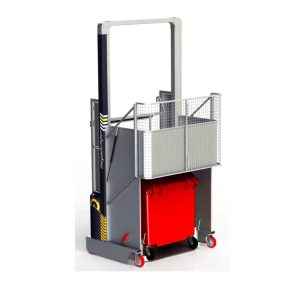
The platform includes guarding, safety interlocks, controlled movement and container-specific cradles. It can also be configured with different power systems and other options depending on the application.
For businesses, this can simplify the process of specifying equipment.
Instead of commissioning an entirely new lifting machine, the application can be assessed against an existing industrial platform and then configured accordingly.
That does not eliminate the need for a site-specific risk assessment, but it can provide a more structured starting point for the equipment selection process.
Simpro Bin Tippers vs Custom Fabrications: What Should You Compare?
When evaluating the two approaches, businesses should consider more than purchase price.
A useful comparison should include:
1. Guarding
Does the machine prevent access to moving and hazardous components?
2. Interlocks
Does the machine prevent operation when guards or doors are open?
3. Load retention
Is the container securely supported throughout the lifting and tipping cycle?
4. Stability
Does the machine maintain appropriate stability as the load is elevated and tipped?
5. Controls
Are controls designed to minimise unintended activation and provide appropriate emergency stopping?
6. Risk assessment
Has the equipment been assessed for the actual environment and operating conditions?
7. Standards
Has the machine been designed and validated against the relevant machinery safety requirements?
8. Maintenance
Can safety-critical components be inspected, tested and maintained?
9. Operator training
Are operators provided with appropriate instructions and training?
10. Application suitability
Is the machine designed for the actual bin, container, load, tipping height and discharge point?
These questions can help businesses make a more informed comparison between Simpro Bin Tippers and custom-built equipment.
So, Which Is Safer?
There is no responsible way to say that every Simpro Bin Tipper will automatically be safer than every custom fabrication.
A professionally engineered custom machine can be designed to a high safety standard, while any industrial machine can become hazardous if it is incorrectly installed, modified, operated or maintained.
The more useful distinction is that Simpro Bin Tippers are purpose-designed machines with integrated safety features and established engineering principles, while the safety of a custom fabrication depends heavily on the specific design, engineering process, risk assessment and validation undertaken for that machine.
The MegaDumper Extra HD provides a particularly strong example. It combines a heavy-duty lifting capacity with full guarding, safety interlocks, controlled lifting and tipping, container-specific cradles and configurable safety systems.
For businesses handling large commercial bins, these factors can be important when evaluating equipment for a particular workplace.
Choosing the Right Bin Tipping Solution
Choosing between Simpro Bin Tippers and a custom-fabricated bin tipping system should begin with the application rather than simply the purchase price or equipment type. The selected solution needs to match the containers, load requirements, tipping height and operating environment in which the equipment will be used.
Start by considering the bin or container being handled, including its dimensions, weight and compatibility with the lifting mechanism. The maximum load and tipping height are particularly important when heavy containers need to be elevated before being emptied into another container, hopper or processing system.
Other factors should also be assessed, including:
- Available floor space and machine footprint
- Required discharge or tipping point
- Frequency of lifting and tipping cycles
- Type and size of containers being handled
- Required lifting and tipping capacity
- Access around the equipment
- Interaction with other machinery or workplace activities
- Guarding and access to moving components
- Maintenance and inspection requirements
For standard or configurable applications, Simpro Bin Tippers such as the Simpro MegaDumper Extra HD can provide an established platform with integrated guarding, safety interlocks and controlled lifting and tipping functions. This can provide a structured starting point when assessing a commercial or industrial bin-handling application.
For highly specialised applications, customisation may be necessary. A custom fabrication can be designed around unusual container dimensions, specific discharge heights, restricted spaces or integration with existing equipment. However, the design should be approached as a complete machinery safety project, rather than simply a fabrication exercise.
This means considering the hazards associated with the entire lifting and tipping cycle. A properly assessed Simpro Bin Tippers application should consider potential crushing and pinch points, load retention, machine stability, access to moving components, unexpected movement and other foreseeable risks.
The goal should always be to identify hazards, reduce risks through appropriate engineering controls and ensure the finished equipment is suitable for its intended operating environment.
For businesses comparing Simpro Bin Tippers with custom fabrication, looking at the complete application provides a more meaningful basis for equipment selection. The focus should be on whether the selected solution provides the required capacity, functionality, safety features and configuration for the specific bin-handling task.
Explore Simpro Bin Tippers
The Simpro MegaDumper Extra HD is designed for heavy-duty bin lifting and tipping applications where controlled movement, guarding, load retention and machine stability are important considerations. With a lifting capacity of up to 750 kg, compatibility with 660 L and 1100 L bins, and tipping heights of up to 1,800 mm in the Emoveit configuration, the MegaDumper Extra HD can be considered for a range of commercial and industrial waste-handling applications.
As part of the Simpro Bin Tippers range, the MegaDumper Extra HD provides a purpose-designed approach to handling larger waste containers. Rather than relying on manual handling or basic lifting equipment, the system is engineered to raise and tip compatible containers in a controlled sequence.
One of the key considerations when selecting Simpro Bin Tippers is the way the equipment integrates safety features into the lifting and tipping process. The MegaDumper Extra HD incorporates guarding and safety interlocks designed to help restrict access to hazardous moving components during operation. These features form part of the machine’s overall safety system and should be considered alongside the site’s own risk assessment, operating procedures and maintenance requirements.
The MegaDumper Extra HD can also be configured for different container requirements. Where standard bin dimensions do not suit a particular application, container-specific cradles and other configuration options may be available. This makes Simpro Bin Tippers relevant to applications where different container types, capacities or discharge requirements need to be considered.
When evaluating Simpro Bin Tippers, businesses should also consider the complete operating environment rather than focusing only on lifting capacity. Factors such as bin dimensions, maximum load, tipping height, discharge location, available floor space, operating frequency and interaction with other equipment can all affect which configuration is appropriate.
For applications involving heavy commercial bins, the MegaDumper Extra HD provides a combination of lifting capacity, controlled tipping and engineered safety features. The suitability of the equipment should nevertheless be assessed against the specific application and workplace conditions before installation and use.
To discuss whether the MegaDumper Extra HD is suitable for your application, contact Emoveit for further information about Simpro Bin Tippers, available configurations and application-specific options.